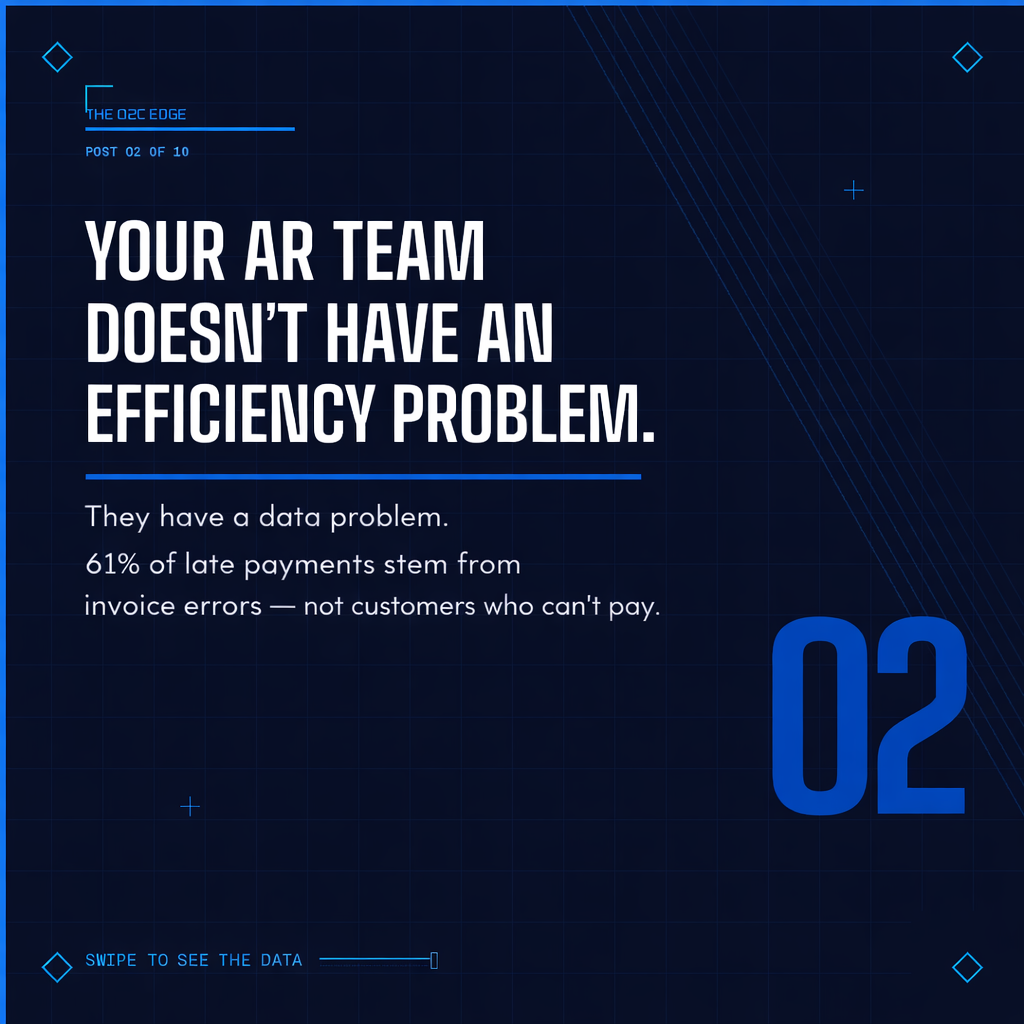
The Diagnosis Is Wrong — And It's Costing You
Here's a conversation I've had more times than I can count.
DSO is climbing. The CFO is asking questions. The VP of Finance pulls together a review and the conclusion is some version of the same thing: the AR team needs to follow up faster, work more accounts, send more reminders. Maybe there's a conversation about adding headcount. Maybe there's a new dunning sequence being built. Maybe someone suggests better collections software.
And six months later, the needle has barely moved.
I've watched this play out at companies of all sizes — from mid-market manufacturers to large enterprise distributors. The intervention was always well-intentioned. The execution was usually solid. But the results were disappointing because the problem was misdiagnosed from the start.
The AR team doesn't have an efficiency problem. They have a data problem.
The gap between what your AR team is capable of and what they're actually delivering isn't about effort, process, or even technology in most cases. It's about the quality, completeness, and connectivity of the information they're working with every single day. Fix the data, and efficiency takes care of itself. Leave the data broken and no amount of process improvement will get you where you need to go.
Let me break down exactly what I mean — and what to do about it.
The Evidence That Points to Data, Not Effort
Before we talk causes, let's look at what the verified numbers actually tell us.
61% of late payments in the U.S. stem from invoice errors. Not customers who can't pay. Not customers who won't pay. Not economic hardship. Invoice errors — wrong PO numbers, incorrect pricing, missing remittance detail — created at the data level, before the invoice ever reached the customer. More than half of your late payment problem originates on your side of the transaction.
That statistic stopped me the first time I saw it. Because if you're chasing those late payments with more calls and more emails, you're working harder on a problem you created. The customer can't pay a dispute-triggering invoice faster just because you followed up more often.
Here's a fuller picture of what the data says:
| Problem Area | Verified Data Point | Source |
|---|---|---|
| Late payments from invoice errors | 61% of U.S. late payments stem from invoice errors | Clockify / ResolvePay 2025 |
| DSO benchmark failure | 70% of companies have DSO exceeding 46 days | Growfin 2025 DSO Benchmarks |
| ERP adequacy for AR | Only 23% of finance teams say their ERP supports all AR processes | ERP Today / HighRadius research |
| AR automation adoption | Only 44% of companies have automated even a few AR tasks | Invensis 2025 |
| Manual cash posting error rate | 12.5% error rate for manual cash posting | PaidNice 2025 AR Statistics |
| B2B invoices overdue globally | Over 50% of global B2B invoices currently overdue | Kaplan Group / Clockify 2025 |
| Annual late payment cost | Average $39,406 per company annually | Kaplan Group 2025 |
| Staff time on collections | 65% of businesses spend ~14 hours/week chasing overdue invoices | Industry aggregate 2025 |
| AR automation market size | $3.40B (2025) → $6.57B (2031) at 11.6% CAGR | Mordor Intelligence |
None of these are efficiency failures. They are data architecture failures that have been dressed up as people problems.
The Five Ways AR Data Breaks Down
In my experience, the data problem in AR isn't one thing. It's five interconnected failure modes that compound each other. Understanding all five is the difference between a technology deployment that moves the needle and one that doesn't.
01 Customer Master Data Fragmentation
The customer master record is the foundation of every AR transaction — billing address, payment terms, credit limits, contact hierarchy, remittance preferences. When it's fragmented or inconsistent, everything downstream suffers.
In any organization that has gone through M&A activity, ERP migrations, or just years of organic growth across business units, the same customer may exist under a dozen variations across systems. Different spellings. Different remittance addresses. Different credit terms negotiated at different times and never reconciled into a single record.
When a payment arrives and your cash application team is trying to match it to an account that's inconsistently defined across three systems, you don't have a collections problem. You have a data architecture problem. The unapplied cash that accumulates in that scenario — cash you've actually received but can't properly post — directly distorts your cash position and your credit decisions.
02 Remittance Data Gaps
Remittance is the single most underappreciated data problem in AR, and I say that as someone who has spent years trying to explain it to people outside of finance.
When a customer pays one invoice for the full amount, matching is simple. That's rarely how B2B payments work. Most enterprise payments cover multiple invoices, include partial payments, and carry deductions — short-pays for price discrepancies, promotional allowances, early payment discounts, damage claims. Each deduction has a different code, a different approval path, and often a different contact at the customer.
Without clean, structured remittance data, your cash application team is manually investigating every exception. Manual payment processing takes an average of 67 minutes per transaction. On high-volume days, that's not a slow team — that's a team that's been put in an impossible position by the quality of the data they're working with.
Making it worse: remittance data arrives in multiple formats. EDI from some customers. PDFs from others. Email remittance advice from smaller accounts. AP portal portals from large retailers. Every format requires normalization before matching is even possible, and most AR teams are still doing that normalization by hand.
03 Siloed Communication and Dispute History
Collections is, at its core, an information-exchange process. A collector's effectiveness depends on their ability to see the full history of a customer relationship — what was invoiced, what was disputed, what was promised, what was already resolved. When that history lives across email threads, ERP notes fields, and shared drives, every interaction starts from near-zero context.
I've seen collectors spend 20 minutes before a customer call just reconstructing the history of a dispute that's been going on for 90 days across a dozen email threads. That's not inefficiency. That's an information architecture failure. The collector is doing exactly what any competent professional would do — trying to get informed before engaging. The system is just working against them.
This compounds dramatically when collectors turn over — which they do frequently. When experienced collectors leave, they take institutional knowledge with them that doesn't exist anywhere in a structured, accessible form.
04 ERP Data Gaps and Integration Failures
The ERP was designed to be the system of record. In a lot of ways it still is. But in modern O2C operations, the ERP rarely contains everything an AR team actually needs to do its job well.
Credit bureau data lives outside the ERP. Customer payment behavior from banking portals and AP networks rarely flows back in. Dispute resolution workflows are often managed in standalone tools. Cash flow forecasting requires pulling from multiple unsynchronized sources. The result is that the "single source of truth" becomes a partial truth — useful for some things, silent on the things that matter most.
When those gaps exist, teams build workarounds: spreadsheets, shadow systems, manual exports that live on someone's desktop. Those workarounds introduce new data quality problems, and the cycle deepens.
Nearly 7 in 10 finance leaders say their ERP does not fully meet AR needs — citing limited automation capabilities, weak analytics, and fragmented cross-system visibility. That's not a vendor failure. That's a recognition that the ERP was built for record-keeping, not for the real-time data intelligence that modern AR requires.
05 No Predictive Data Layer
This is the failure mode that carries the most consequence, and the one that's hardest to see until you've experienced what's possible on the other side.
Traditional AR operates entirely in the rearview mirror. The aging report — the backbone of most collections operations — tells you what's already past due. By definition, it's a backward-looking view of problems that have already happened. Teams respond by chasing what's overdue, escalating what's aged badly, and writing off what's unrecoverable.
What's missing is the forward-looking layer: which accounts are likely to go past due in the next 30 days, which customers show early signs of credit deterioration, which deductions are trending toward dispute, which invoices have a 70% probability of being paid without intervention and which need attention now.
Without that predictive signal — built on clean, unified, historical behavioral data — AR teams are permanently reactive. They will always be working problems after they've already become problems.
What Solving the Data Problem Actually Looks Like
When I talk about fixing the AR data problem, I'm not talking about a data cleanup project. I'm talking about deploying tools that intervene at the data layer — unifying, enriching, and generating predictive signal from the information your AR team already has access to, just not in a usable form.
The current generation of AI-driven AR platforms does exactly this. Here's what the best of them are delivering, with real customer results:
Cash Application and Remittance Intelligence
HighRadius is recognized in the Gartner Magic Quadrant for Invoice-to-Cash Applications and processes over $5 trillion in receivables annually across its platform. The results from named customers are worth reading carefully:
Danone recovered $20 million annually in previously unrecovered invalid deductions — and achieved 96% cash forecasting accuracy post-implementation. Konica Minolta cut DSO by 9 days and generated $3.5 million in payment processing savings. Lodge Cast Iron reduced past-due invoices by 13% and improved DSO by 5 days.
Billtrust has held the G2 Leader position for AR Automation for 19 consecutive quarters — the longest sustained streak in that category. But what I find most compelling about Billtrust isn't a vendor claim — it's independent third-party validation. IDC published research in 2025 showing Billtrust customers achieve a 384% ROI, with $4.84 in benefits returned for every $1 spent, an average payback period of just 9 months, and 52% more transactions handled per AR team member. That's not a case study cherry-picked by a marketing team. That's IDC running the numbers independently across the customer base.
Billtrust also connects to 260+ AP portals, which solves one of the messiest remittance normalization problems in mid-market and enterprise AR.
Esker — named a Leader in the 2025 Gartner Magic Quadrant for Accounts Payable Applications — offers some of the most direct case evidence I've seen on the remittance problem. Fletcher Steel saw complex payments with 800+ line items drop from hours to minutes in processing time. At Eagle Family Foods, Cash Application Lead Nancy Hennings put it simply:
"It could take 2–3 days to post one day of cash. After Esker, our 2 people are done by 2pm for prior day."
That's the remittance data problem solved in a single sentence.
Emagia has delivered over 90% automated cash application at a global oil and gas company, and achieved a 75% reduction in outstanding chargebacks within six weeks of deployment at a healthcare services company. Across its customer base, manual reconciliation has dropped by up to 70%.
Collections Prioritization and the Predictive Layer
HighRadius is also the dominant platform in AI-powered collections, with its agentic AI self-steering outreach dynamically based on real-time payment behavior and risk signals. Staples reduced bad debt by 20% through HighRadius collections automation. Across the platform, customers report 50%+ reductions in manual follow-up work and 1,000+ work hours recovered per month from dunning automation alone.
BlackLine was cited by Forrester in their 2025 Top AI Use Cases for Accounts Receivable Automation report specifically for Collection Management, Explainability and Transparency, and AI Bias handling. For organizations where auditability and AI transparency matter — regulated industries, public companies — BlackLine's AR Intelligence platform delivers AI copilot capabilities that auto-triage exceptions and prescribe collector actions while maintaining full model explainability.
Gaviti takes a modular approach — companies select only the features they need — and has delivered 30–50% DSO reductions within 6 months across its customer base. Its AI predicts late payments before they become overdue, which is the fundamental shift from reactive to proactive that the aging-report model can never achieve.
Versapay approaches the problem differently: its "Collaborative AR" model connects supplier AR data with customer AP data in a shared portal. The result is 82% self-service adoption among Versapay customers — versus a 20% industry average for AR self-service portals. If your DSO problem is primarily dispute-driven, this data transparency model addresses the root cause rather than just following up on the outcome.
Growfin is worth knowing about for fast-growing companies that need to modernize AR operations without the complexity or cost of a full enterprise platform. Capterra-verified reviews show 30% reductions in outstanding receivables and 27% cash flow increases among Growfin customers.
Cash Flow Forecasting and the Predictive Intelligence Layer
Tesorio is the platform I've seen generate some of the most concrete, named cash flow results in the market. Operating with native connectors into SAP, Oracle, NetSuite, and Salesforce:
Discovery Education reduced DSO by 66% — collection period dropped from 96.8 days to 59 days. Couchbase cut DSO by 10 days and critically avoided raising capital for three years before their IPO — because their cash position was finally visible and accurate. One enterprise customer freed $28.7 million in working capital through a 42-day DSO reduction, achieved 93% forecast accuracy, and reduced customer disputes by 78%.
Across Tesorio's customer base, the platform reports 95% cash flow forecast accuracy and an average 12-day DSO reduction in the first quarter of deployment.
Where to Start If You're Recognizing This Problem
If you're reading this and recognizing pieces of your operation in the failure modes above, the starting point isn't a platform selection exercise. It's an honest diagnostic.
| Symptom You're Experiencing | Likely Root Cause | Platform Category to Evaluate |
|---|---|---|
| Unapplied cash accumulating; manual posting errors | Remittance data gaps; customer master fragmentation | Cash application AI (HighRadius, Billtrust, Esker, Emagia) |
| Collectors rebuilding context before every call | Siloed dispute history; no unified communication record | Collaborative AR / Collections AI (Versapay, Gaviti, Growfin) |
| AR following up on invoices customers dispute as incorrect | Customer master or invoice data errors | Cash application + ERP integration layer |
| Collections team working aging reports reactively | No predictive data layer | AI-prioritized collections (HighRadius, BlackLine, Gaviti) |
| Cash flow forecasting done in spreadsheets | ERP data gaps; no predictive AR layer | Finance AI platforms (Tesorio, SAP S/4HANA Finance) |
| DSO climbing despite team effort and process improvements | Multiple data failure modes compounding | Full AR data platform evaluation |
Ask yourself these questions before you evaluate any new tool:
Where does your customer master data live, and how many versions of it exist? If the answer involves multiple systems that don't always agree, you have a unification problem that will undermine every other technology investment.
How does remittance data arrive, and what happens when it's incomplete? If manual intervention is the default rather than the exception, you're looking at a data normalization gap that's eating 67 minutes per transaction.
Where does your dispute and communication history live? If the answer is "email and ERP notes," you're losing institutional knowledge every time a collector leaves.
What does your cash flow forecast rely on? If the answer involves a manual ERP pull and a spreadsheet, you don't have a forecasting problem — you have a data integration problem that's preventing accurate forecasting.
Are you working aging reports or predictive worklists? If it's aging reports, you're reactive by design. The question is whether that's still acceptable.
The Bottom Line
The AR automation market is growing from $3.40 billion today to an estimated $6.57 billion by 2031. That growth isn't driven by companies automating the same old workflows faster. It's driven by companies finally solving the underlying data problems that have been undermining AR performance for years.
The numbers are clear enough: a Billtrust implementation independently verified by IDC at 384% ROI. Danone recovering $20 million annually in invalid deductions through HighRadius AI. Discovery Education cutting DSO by 66% with Tesorio. Couchbase avoiding a capital raise because, for the first time, their cash position was actually accurate.
None of those outcomes came from working harder or following up more often. They came from fixing the data.
Before you open another headcount requisition, before you build another dunning sequence, before you redesign another collections workflow — stop and ask whether the problem you're trying to solve is actually a data problem in disguise.
In my experience, it usually is.
The AR teams winning right now aren't the ones working harder. They're the ones who finally have the right information, in the right form, at the right time — and they're using it to predict and prevent problems instead of reacting to them.
This is part of The O2C Edge — Where AI meets Order-to-Cash operations.
References
- Late Invoice Statistics — Clockify
- B2B Payment Delay Statistics — The Kaplan Group
- 2025 DSO Benchmarks — Growfin
- AR Automation Market — Mordor Intelligence
- 25 AR Statistics — PaidNice
- Impact of AI on O2C — Invensis
- HighRadius Yaskawa Case Study
- HighRadius Staples Case Study
- Billtrust 2025 Milestones — PR Newswire
- Esker Named Leader in Gartner AP Applications MQ
- BlackLine Recognized in Forrester Top AI Use Cases 2025
- Gaviti AI in Collections
- Versapay AR Automation — Cash Application
- Growfin Capterra Reviews
- Tesorio AI Cash Flow Platform
- Emagia AI in AR — Real Use Cases