The Revenue Leak Nobody Talks About
There's a conversation most finance leaders have had — usually around the time a major account shows up in the churn report.
The question that follows is almost always the same: when did we know this account was at risk? And the answer, more often than not, is uncomfortable. We didn't know. Or we knew too late. Or someone knew, but the signal never surfaced in a form that could drive action.
That conversation is happening in every industry, at every scale. And the stakes are significant.
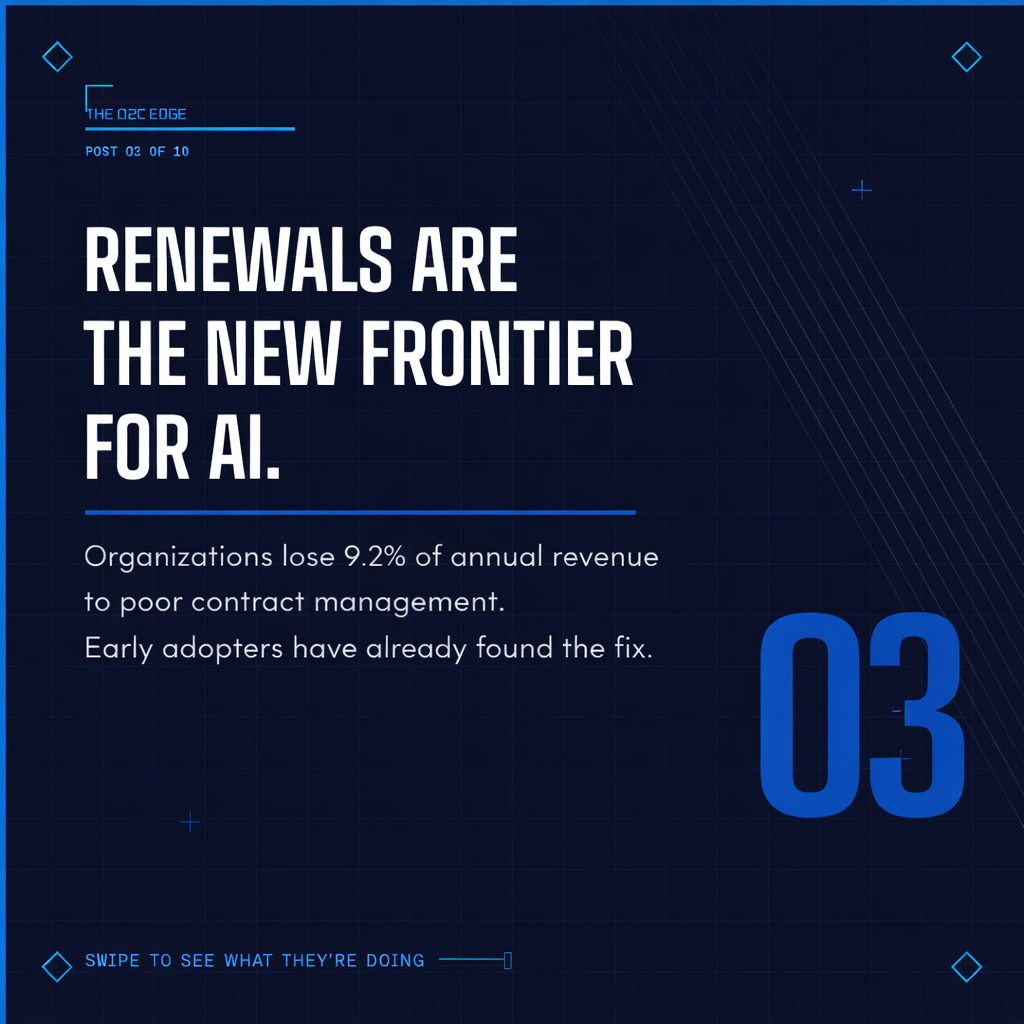
Research from World Commerce & Contracting puts the average revenue lost to poor contract management at 9.2% of annual revenue. For average performers, that number climbs to 12.4%. Even best-in-class organizations still lose 6.2%. The root cause is almost always the same combination of factors: contracts are fragmented, renewal dates are tracked passively, and no one has visibility into which accounts are drifting toward non-renewal until the conversation is already too late.
For a $100 million company running at the average, that's $12 million a year in preventable loss. Not from economic headwinds. Not from a competitor undercutting price. From information that existed inside the organization and never got surfaced in the right form at the right time.
The organizations that are changing this equation aren't doing it with more customer success headcount or more aggressive renewal playbooks. They're doing it with AI — specifically, AI that converts the passive, calendar-driven renewal process into a predictive, data-driven discipline.
Here's what's working.
Why the Traditional Renewal Process Fails
Before we get to the tools, it's worth being honest about why the standard approach breaks down. Because the failure modes are consistent enough that they look less like isolated problems and more like structural design flaws.
Contracts are scattered. According to World Commerce and Contracting, nearly 50% of organizations fail to track at least some of their contracts effectively. When contracts live across email threads, shared drives, ERPs, CRMs, and legal document repositories — often in different formats with no unified ownership of renewal dates — critical windows close before anyone realizes they were approaching.
Tracking is reactive. Most renewal management relies on calendar alerts set at contract execution. That tells a team that a renewal is coming. It tells them nothing about whether the customer is satisfied, whether the pricing is still competitive, whether usage has declined, or whether a competitor has been in the account for the past 90 days. A calendar alert is better than nothing. It's not a strategy.
There's no early warning system. Without behavioral data — product adoption trends, payment history, support ticket patterns, communication sentiment — teams have no mechanism to identify at-risk accounts before they're already in cancellation mode. The signals exist. They're just siloed across systems that rarely talk to each other, and they're never aggregated into a risk score that routes accounts to the right people at the right time.
The math breaks down on long-tail accounts. In most enterprise businesses, the top 20% of customers get active, relationship-based renewal management. The remaining 80% get a renewal notice and maybe a follow-up email. But those long-tail accounts often represent 30–40% of total ARR. There's not enough capacity for human-led outreach at that scale — which is exactly where AI changes the equation.
What AI Is Actually Doing in Renewals Right Now
The platforms solving the renewal problem fall into three distinct categories. The best O2C and revenue operations leaders I know are thinking across all three — because each addresses a different layer of the problem.
Revenue Intelligence: Knowing What's About to Happen
The first layer is forecasting — not just "is this account likely to renew" but "how much of our renewal pipeline is real, which accounts are at risk, and where should we focus right now."
Clari is the most prominent platform in this space, and the numbers behind what it delivers are worth examining carefully. A Forrester Consulting Total Economic Impact study commissioned in 2025 found that enterprises running on the Clari Revenue Orchestration Platform achieved a 398% ROI over three years, with $96.2 million in total benefits for the composite enterprise customer and payback in under six months. Customer retention drove $52.3 million in revenue growth within that total, with a +20-point increase in renewal rates.
That's not a vendor claim. That's a Forrester-modeled, independently calculated outcome across a composite of real customers. More than 1,500 enterprise organizations — including Adobe, HPE, Cisco, Okta, Thermo Fisher Scientific, and Zoom — run revenue on Clari.
There's a counterweight here that's worth naming. Clari Labs published research in 2025 showing that 87% of enterprises missed revenue targets despite record AI investment in the same year. The lesson isn't that AI doesn't work — it's that deployment and workflow integration matter as much as the technology itself. Having Clari doesn't deliver these outcomes. Using it in a way that actually changes how renewal forecasting and escalation decisions are made is what delivers them.
Customer Success Execution: Acting on What the AI Surfaces
Knowing which accounts are at risk is half the battle. The other half is having a system that acts on that intelligence — particularly in the long-tail segments where human-led outreach doesn't scale.
This is the problem Gainsight set out to solve with its Atlas AI agents, launched in May 2025. Atlas introduced what Gainsight describes as the industry's first dedicated Renewal AI Agent — purpose-built for scaled renewal execution in long-tail segments. The agent delivers hyper-personalized engagement by replicating the strategies of top-performing CSMs: surfacing at-risk signals, automating lower-touch interactions, and escalating high-risk accounts to human team members before the renewal window closes.
For companies with tens of thousands of smaller customers and a lean CS team, this fills a gap that no amount of hiring could solve economically. Mindbody — operating exactly that model — called Atlas "the breakthrough we've been waiting for," describing AI agents that personalize outreach, learn in real time, and proactively address adoption challenges as exactly what modern customer success teams need.
Gainsight's published benchmarks for AI-driven renewal management show up to 130% ROI and 95% renewal pipeline forecasting accuracy. The precision at that accuracy level changes the economics of renewal planning: instead of building conservative ARR forecasts with wide risk buffers, finance teams can plan against a number that's actually reliable.
Contract Intelligence: Enforcing What Was Agreed
There's a layer to the renewal problem that most customer success conversations miss entirely: what happens when the contract itself is the source of revenue leakage.
Unauthorized discounts that continue past their term. Price escalation clauses that never trigger because no one is monitoring them. Renewal options that were negotiated favorably but expire without activation. Obligations that were agreed to in the contract language but never enforced downstream.
This is the problem that contract intelligence platforms are built to solve — and the scale of the opportunity is significant. Organizations lose an average of $200,000 annually from missed renewal opportunities alone, and the broader contract management problem accounts for that 9.2% revenue leakage number.
Icertis is the dominant platform in this space. It's trusted by more than one-third of the Fortune 100, holds a Leader position in the 2025 IDC MarketScape for AI-Enabled Buy-Side CLM, earned Gartner Customers' Choice status in 2025 (with 93% of customers recommending the platform), and is the only Leader to earn a "halo" in the Forrester Wave for Contract Lifecycle Management for exceptional customer feedback scores. New 2025 customers include McDonald's, BMW, Booz Allen Hamilton, and two of the four largest U.S. banks.
The most direct case study for what this looks like in practice: a Fortune 500 pharmaceutical company — ranked #42 on the Fortune 500 — saved $70 million annually by using Icertis to enforce commercial terms across 250,000+ supplier contracts in 17 languages. That's not a DSO story. That's a contract intelligence story: the AI found the money that was agreed to and made sure the organization actually collected it.
Conga addresses a closely related problem from the CPQ side — the quote-to-contract junction where renewal pricing, terms, and subscription adjustments typically break down in manual environments. Named the 2025 Gartner Customers' Choice for CPQ for the second consecutive year and recognized as a 2025 market leader by both IDC and ISG, Conga customers report a 62% reduction in quote-to-cash cycle times on average. In February 2026, Conga acquired PROS Holdings' B2B business, adding AI-driven pricing intelligence to create a unified quote-to-contract-to-revenue workflow.
Ironclad rounds out this category from the legal and commercial contract management angle. Ironclad surpassed $200 million in ARR in February 2026, and its 2025 Contracting Benchmark Report found that organizations using CLM software showed an average 55% improvement across value metrics compared to those without. Its AI-powered renewal tracking and conversational AI interface — launched in January 2026 — allows finance and legal teams to query their entire contract portfolio in natural language. Automated alerts reduce time spent manually tracking renewals by 75–90%; proactive renegotiation through AI-surfaced windows enables companies to save 15–25% on renewed contracts compared to reactive handling.
The O2C Angle Most People Miss
Here's the frame I want to bring to this that doesn't always show up in the CLM or customer success conversation: renewals are an O2C problem.
Revenue doesn't close when a deal is signed. It closes when it's invoiced, when it's paid, and when it renews. The entire order-to-cash cycle restarts at each renewal event — and every failure in the renewal process creates downstream O2C problems: delayed invoicing, disputed billing on auto-renewed terms the customer didn't validate, unapplied cash from partial payments on misquoted renewal invoices.
The organizations that are winning here aren't treating renewals as a sales problem or a customer success problem in isolation. They're treating the renewal process as an integrated O2C workflow: contract terms flowing cleanly into billing, renewal pricing flowing cleanly into invoicing, payment behavior feeding back into renewal risk models, and AR data informing customer health scores.
When those loops are connected — when Icertis or Ironclad is sharing contract data with the ERP, when Clari's renewal risk scores are informing collections prioritization, when Gainsight's health signals are feeding into cash flow forecasts — the renewal process stops being a discrete event and starts being a continuous discipline.
That's where the real competitive advantage lives.
Where to Start If You're Recognizing This Problem
| Symptom | Root Cause | Category to Evaluate |
|---|---|---|
| Renewals missed or processed late | No unified contract tracking; calendar-only alerts | CLM platform (Ironclad, Icertis) |
| At-risk accounts surfacing after they've already decided | No predictive churn signal | Revenue intelligence (Clari) |
| Long-tail renewals handled reactively or not at all | CS capacity gap; no automation in low-touch segments | CS AI platform (Gainsight Atlas) |
| Renewal pricing wrong or favorable terms not enforced | CPQ/CLM integration gap; no commercial term enforcement | Contract intelligence (Icertis, Conga) |
| Renewal revenue forecasts consistently wrong | No AI-powered pipeline modeling | Revenue orchestration (Clari) |
| Post-renewal billing disputes and invoice errors | Renewal terms not flowing cleanly into billing | CPQ + CLM integration (Conga) |
The right starting point depends on where your biggest revenue leakage is occurring. For most organizations, the honest answer is: in more than one place simultaneously. Which is why the O2C lens matters — it forces you to see the whole chain rather than fixing one piece in isolation while the rest continues to leak.
The Bottom Line
The CLM and renewal AI market is growing from $1.4 billion today to over $4 billion by 2034 — not because software vendors are good at selling, but because the cost of doing nothing is finally being quantified.
9.2% of annual revenue. For a $200 million company, that's $18 million a year, quietly disappearing into missed renewals, unenforced contract terms, at-risk accounts that nobody saw coming, and long-tail customers who churned without a conversation.
The tools to solve it exist. Clari with a Forrester-verified 398% ROI and +20 points of renewal rate improvement. Gainsight Atlas with the first AI-native renewal execution agent. Icertis with Fortune 100 adoption and $70 million in recovered annual value at a single pharma company. Conga with a 62% reduction in quote-to-cash cycle times. Ironclad with 75–90% less time spent on manual renewal tracking.
Early adopters are deploying these now. The organizations that treat this as a future-state initiative are handing market share to competitors who are already closing the gap.
The question isn't whether AI can improve your renewal economics. The question is how much longer you want to find out what that 9% is costing you every year before you do something about it.
This is part of The O2C Edge — Where AI meets Order-to-Cash operations.
References
- Revenue Leakage — Hyperstart
- How Can CFOs Stop the 9% Revenue Leak — GrowCFO
- Zero Missed Renewals: AI Alerts — ContractSPAN
- CLM Market Size 2025–2034 — Custom Market Insights
- Clari Revenue AI Delivered $96.2M — Clari Press
- Customer Retention and Expansion with Clari
- Gainsight Launches Atlas — GlobeNewswire
- Gainsight Atlas AI Agents for Retention
- Icertis Named Leader in 2025 IDC MarketScape
- Icertis Gartner Customers' Choice 2025 — Business Wire
- Conga Gartner CPQ Customers' Choice 2025
- Conga Contract Renewal Management
- Ironclad AI Contract Management
- Ironclad AI Agents Launch 2026
- CLM Market Forecast — Grand View Research