
There is no shortage of AI tools competing for your attention right now. But most of the conversation treats all AI like one category — a single smart assistant you type questions into and hope for good output. That framing misses something important about how Anthropic has actually built Claude.
Claude isn't one tool. It's three distinct products built for three distinct modes of work — and now a fourth layer, the Claude Marketplace, that changes how enterprises procure and deploy the tools built on top of it. And if you're in Order-to-Cash (O2C) operations, understanding the difference between Claude Chat, Claude Cowork, Claude Code, and the new Marketplace isn't just a technology education exercise — it's the difference between using AI at the margins and actually building it into your workflow.
I've been using the first three. Here's what each one actually does, where it fits in O2C, and the tips that changed how I work with each of them. And at the end, I'll explain why the Marketplace matters to every O2C team that has an Anthropic commitment.
The Four Layers — A Quick Map
Before we go deep, here's the orientation:
Claude Chat is the browser-based assistant at claude.ai. Conversational, available from any browser, no installation required. Most people start here. Most people stay here longer than they should before moving on.
Claude Cowork is a desktop application (Mac and Windows) that launched as a research preview on January 12, 2026. It's an agent that lives on your machine — accessing files, running tasks across connected tools, and executing multi-step workflows on your behalf. Think of it as Claude Chat, but Claude can actually do things instead of just talking about them.
Claude Code is a terminal-based agentic coding environment. No GUI. It lives in your command line, reads your codebase, writes and runs scripts, commits to Git, and can work autonomously through hours-long tasks while you focus elsewhere. It reached $2.5 billion in annualized run-rate revenue by February 2026 — more than doubling since January 1 — and enterprise use now represents more than half of all Claude Code revenue.
Claude Marketplace is a new enterprise procurement platform launched on March 6, 2026, that lets organizations with existing Anthropic spend commitments purchase Claude-powered tools from vetted third-party partners — with Anthropic consolidating all invoicing.
These aren't different UI skins of the same product. They are fundamentally different tools for different users doing different work.
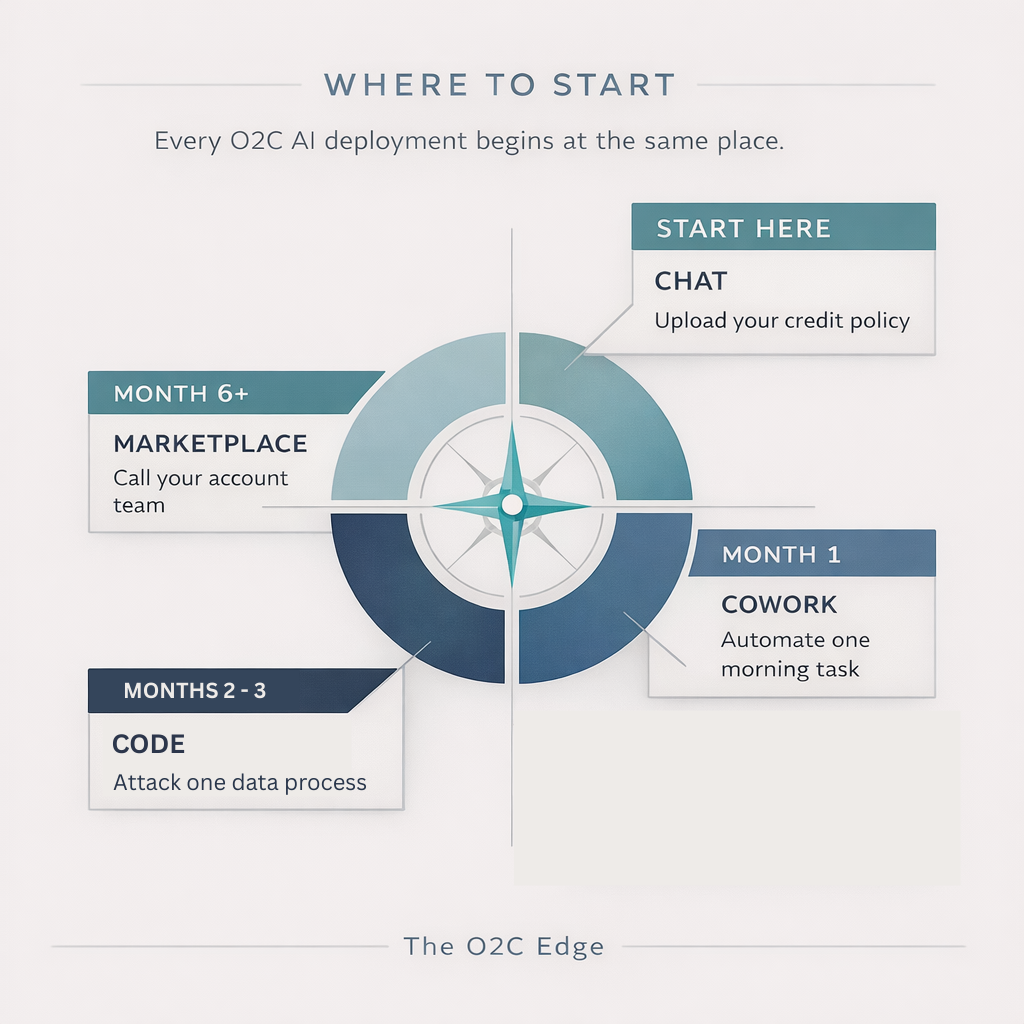
The Four Layers — four distinct tools for four distinct modes of work.
Claude Chat — The One You Already Know, Used Better
Most O2C professionals who've used Claude at all are using Chat. And most are using it in the most basic way: typing a question, reading the answer, repeating.
That's fine. But Chat has layers that most people never reach.
Where Chat Actually Moves the Needle in O2C
Collections communication is where I've seen the most immediate impact. Writing a collections email that is simultaneously firm, professional, and relationship-preserving is harder than it looks — especially when you're writing the same type of email 40 times a week for different customers at different stages of the collection cycle. Chat can hold your specific tone requirements, your company's escalation policy, and the customer context in a single conversation thread and generate drafts that actually sound like you.
Contract and credit analysis is the other standout. When I'm reviewing a new customer's credit application, a contract with unusual payment terms, or a dispute response that references obscure language buried on page 14 of an MSA (Master Service Agreement) — Claude Chat can read the document and surface what matters faster than many manual review processes. Give it a credit report PDF and ask it to extract the key risk indicators. Give it a contract and ask where the deduction rights language lives. It can meaningfully reduce the time spent on document-heavy tasks.
SOP and policy documentation is underused. If you've ever had to document an AR (accounts receivable) escalation workflow, a deduction processing procedure, or a new-customer onboarding checklist — Chat can take a rough verbal description and turn it into formatted, audit-ready documentation. This is one of those tasks that no one has time for and Chat makes painless.
Tips for Getting More From Claude Chat in O2C
Stop treating it like Google. The biggest mistake is sending one-line queries. Claude Chat works best when you give it full context: the customer, the situation, the outcome you're trying to achieve, and any constraints. More context = dramatically better output.
Use Projects. Claude's Projects feature lets you create a persistent workspace with custom instructions and uploaded documents. If you're using Chat for collections work, create an O2C project with your company's credit policy, your collections email templates, and your standard deduction response procedures already uploaded. Every conversation in that project has access to those documents automatically.
Iterate, don't restart. Claude Chat handles multi-turn refinement well. Don't start a new conversation every time a draft isn't quite right — ask it to revise, explain why, and specify what needs to change. The conversation history is context Claude actively uses.
Be explicit about format. "Write a collections email" will produce something generic. "Write a collections email to a net-60 customer that is 45 days past due on a $28,000 invoice, reference the invoice number, keep the tone professional but firm, do not offer a payment plan, and close with a specific call to action asking for a response by Friday" will produce something usable.
Claude Cowork — The Desktop Agent That Actually Does the Work
Cowork is the product that changes the frame for O2C teams that are drowning in repetitive, structured tasks. Chat advises. Cowork acts.
When Anthropic launched it on January 12, 2026, TechCrunch described it as offering "Claude Code without the code" — a way for non-technical users to get the power of an agent that can take real actions on files and connected systems, without needing a terminal or programming knowledge.
That framing is accurate. Here's what that means for O2C work specifically.
What Cowork Can Do
Cowork's core capability is running multi-step tasks across your file system and connected tools. You grant it access to specific folders on your machine. You install connectors for the external tools you use. Then you give it a task — not a question, a task — and it executes.
As of February 24, 2026, the connector library includes:
| Connector | Use in O2C |
|---|---|
| Google Workspace (Calendar, Drive, Gmail) | Automate AR reporting, draft collections emails, manage schedules |
| Microsoft 365 (Excel, PowerPoint) | Cross-app workflows: data from Excel → formatted PowerPoint decks |
| DocuSign | Contract and credit agreement workflows |
| FactSet & MSCI | Institutional market data (requires existing subscriptions) |
| Apollo, Clay, Outreach | Customer contact and outreach automation |
| Harvey & LegalZoom | Contract review and legal workflow support |
| LSEG & S&P Global | Financial data via partner-built plugins (requires data entitlements) |
| Salesforce-ecosystem workflows | Available via the Slack by Salesforce partner plugin |
The Finance Plugins Worth Knowing
Anthropic's finance-specific plugins give Cowork real depth for financial work.
Financial Analysis (Core) connects to Daloopa, Morningstar, S&P Global, FactSet, Moody's, LSEG, PitchBook, and Egnyte. It's built for comparable company analyses, DCF models, and financial statements — but the underlying data access and modeling logic applies to credit analysis and counterparty risk profiling as well.
Investment Banking, Equity Research, Private Equity, and Wealth Management plugins round out the suite. For O2C teams doing credit underwriting on large commercial accounts, the ability to pull real-time market data, earnings data, and fundamental analysis into Claude's context without switching tools can meaningfully reduce research time.
All five Anthropic-built finance plugins are open source and available at no additional cost. The FactSet, MSCI, LSEG, and S&P Global connectors require active data subscriptions with those providers.
The Scheduled Tasks Feature Is the One That Changes Daily Workflows
On February 25, 2026, Anthropic launched scheduled tasks in Cowork. This is the feature I'd highlight above everything else for O2C teams.
The concept is simple: write a prompt once, set a schedule, and Claude runs it automatically. Daily. Weekly. Monthly. On demand. With full access to all your connected tools and installed plugins.
In practice for O2C, that could look like this:
| Schedule | What Cowork Does |
|---|---|
| Every morning at 6 AM | Reads your AR aging export from the folder your ERP saves to overnight, formats it into a clean summary, and drafts a status update you can review when you arrive |
| Every Monday | Pulls from your collections tracker, identifies accounts moving to a new aging bucket, and prepares the outreach list |
| Last business day of the month | Reads your DSO tracking spreadsheet, calculates the current month's performance, and populates the executive summary slide in PowerPoint |
None of this requires coding. It requires a good prompt, the right connectors, and a scheduled task.
Cross-App Excel to PowerPoint Workflows
The February 24 update also launched cross-app workflows between Excel and PowerPoint — Cowork can carry full context between the two applications within a single session. For finance teams who spend hours moving data from models into decks, this removes the manual copy-paste or custom VBA macro workaround. As of this writing, the feature is in research preview for paid users on Mac and Windows.
Cowork Best Practices for O2C Teams
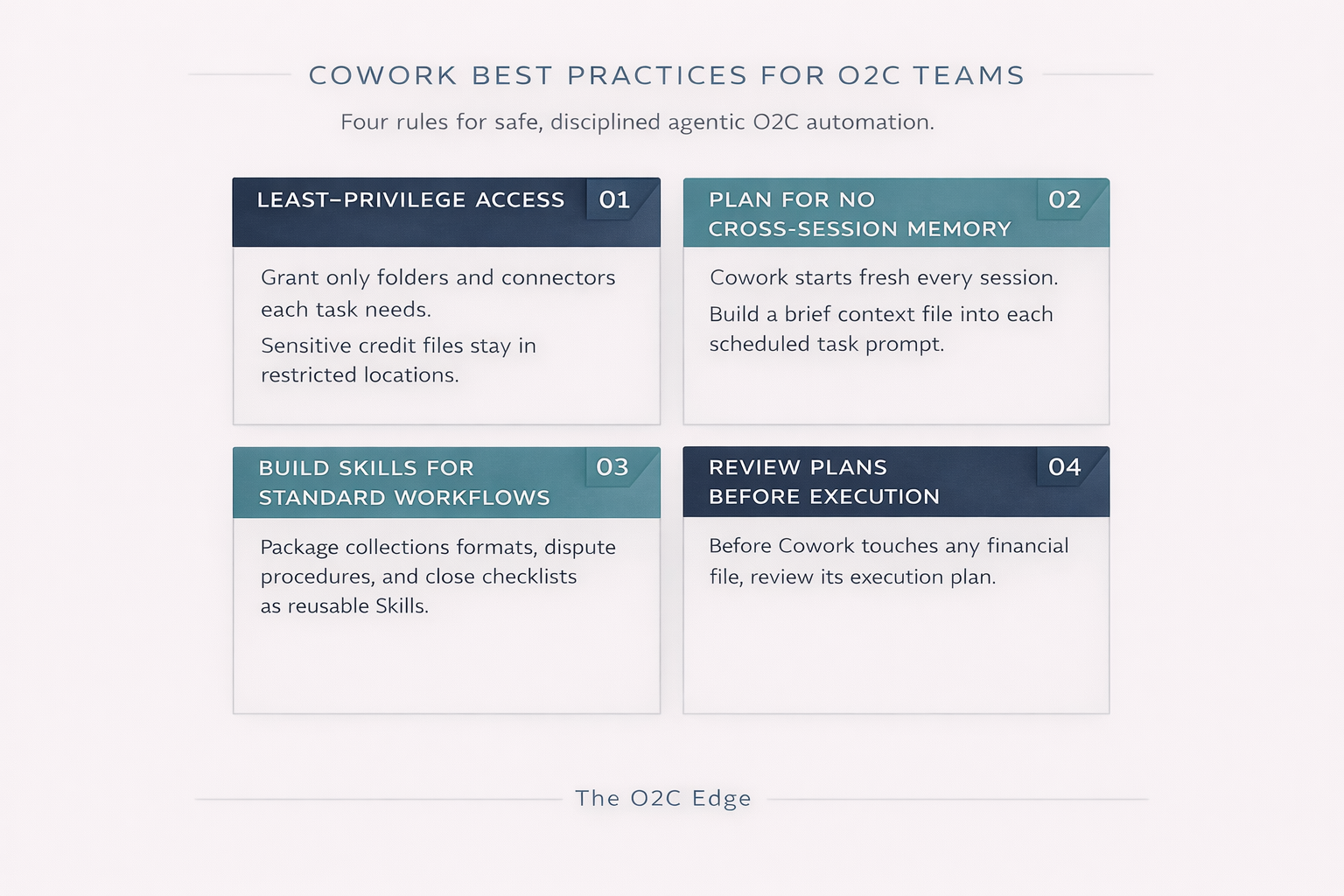
Cowork Best Practices — four rules for safe, disciplined agentic O2C automation.
Least-privilege folder access. Only grant Cowork access to the specific folders it needs to complete a task. Sensitive financial data — especially customer credit files, bank information, or anything governed by data handling policies — should remain in separate, restricted folders. This isn't paranoia; it's good data hygiene that applies to any agent system.
No cross-session memory — plan for it. Cowork starts every session completely fresh with no memory of previous conversations or tasks. For recurring workflows, build a brief context file that you include at the start of each session (or build it into your scheduled task prompt): your company name, the relevant folder structure, the output format you expect, and any conventions Claude should follow.
Build Skills for your standard O2C workflows. Cowork's Skills system lets you package custom instructions, scripts, and reference materials into reusable folders that Claude loads automatically when triggered. If you have a recurring collections report format, a standard dispute response structure, or a monthly close checklist — build a Skill for it. You write it once, and every subsequent Cowork session can apply it without re-prompting.
Require plan review before execution on financial files. Before Cowork modifies any file that touches financial records, build a "plan first, act second" step into your workflow. Cowork will present what it plans to do before executing — always review that plan when real data is involved.
Claude Code — The One That Builds the Tools
Claude Code is different in kind, not just degree. This isn't an agent helping you manage your existing workflows. This is a tool that builds new ones.
If you have technical resources — a developer, a data engineer, even a technically literate finance analyst — Claude Code is how you turn O2C pain points into automated solutions without waiting for IT project timelines or third-party vendor roadmaps.
What Claude Code Actually Does
Claude Code lives in the terminal. When you launch it, it reads your entire codebase, understands the structure, and works from a CLAUDE.md project file where you document your conventions, data structures, and business rules. Then it writes code, runs it, fixes errors, commits to Git, and works through complex multi-step tasks autonomously.
As of early 2026, Claude Opus 4.5 scored 80.9% on SWE-bench Verified — the first model to exceed 80% on this benchmark, which tests AI ability to resolve real software issues from GitHub repositories. An 80% score means the model can resolve approximately 4 out of 5 real-world software engineering tasks without human intervention — an impressive baseline, though real-world performance will vary with codebase complexity and task specificity.
Industry analysts at SemiAnalysis estimate that Claude Code now authors approximately 4% of all public GitHub commits — roughly 135,000 per day as of early February 2026. SemiAnalysis projects that share could exceed 20% of daily commits by the end of 2026 if current growth rates continue — though this should be understood as an analyst projection, not a certainty.
The $2.5 Billion Signal
The revenue number matters for O2C leaders, and not because you care about Anthropic's financials. It matters because it tells you something about enterprise adoption velocity.
Claude Code launched publicly in May 2025. By early February 2026 — just nine months later — it had reached over $2.5 billion in annualized run-rate revenue, with business subscriptions quadrupling since January 1 alone. Enterprise use now accounts for more than half of Claude Code revenue.
8 of 10 Fortune 10 companies use Claude — confirmed by Anthropic in its February 2026 Series G announcement. The number of customers spending over $100,000 annually grew 7x in one year, and more than 500 customers now spend over $1 million annually. Claude Code is now included in Anthropic's Team and Enterprise bundles because it was the most-requested feature from enterprise customers.
This is not a developer toy gaining traction. This is enterprise software moving at a speed the industry hasn't previously seen.
O2C Use Cases Where Claude Code Builds Real Solutions
Invoice and Remittance Processing
The most immediately applicable O2C use case: automating the ingestion, extraction, and validation of invoice and remittance data. Claude Code can build Python tools that read PDF invoices, extract structured data (invoice number, date, amount, line items, vendor ID), validate against your customer/supplier master records, and prepare entries for ERP upload — all in a single automated pipeline.
One documented capability: spawning parallel sub-agents to process multiple PDF documents simultaneously — one agent per document, running in parallel — for both speed and accuracy. For teams processing hundreds of remittance files per day in varied formats, this is the path from manual to automated without a multi-year AR platform implementation.
AR Reporting and Dashboard Automation
Building custom AR reporting scripts that pull from ERP data exports, apply your specific business logic (custom aging buckets, custom customer segments, custom collection status definitions), and output to Excel or PowerPoint in the exact format your CFO expects. This can replace hours of manual Excel work that most AR teams repeat every week.
ERP Integration and API Connectors
Writing connection scripts between your AR platform and your ERP, between your collections tool and your CRM, between your customer portal and your reporting system. These are exactly the integration gaps that exist in most O2C stacks because the vendor either doesn't support it natively or charges significant professional services fees to implement. Claude Code can build working first-draft connectors that your technical team can then validate and extend.
Cash Application Exception Handling
Building scripts that normalize remittance advice formats from email, EDI, and portal sources — matching payment data to open invoices, flagging exceptions, and generating exception summary reports for manual review. This is the front-door automation that lets your cash application team focus on the exceptions that actually require judgment rather than spending the majority of their day on mechanical matching work.
Claude Code Security — The New Layer Worth Knowing
On February 5, 2026, Anthropic's Frontier Red Team published research showing that Claude Opus 4.6 had found and validated more than 500 high-severity zero-day vulnerabilities in production open-source software — bugs that had survived decades of expert review and millions of CPU hours of fuzzer coverage. Anthropic then launched Claude Code Security as a product in February 2026, making this reasoning-based vulnerability scanning available to developers.
Rather than pattern-matching against known vulnerabilities like legacy scanners, Claude Code Security reasons about code the way a human security researcher would: understanding how components interact, tracing how data flows through applications, and catching complex vulnerabilities that rule-based tools miss.
For O2C teams building custom automation scripts, payment processing connectors, or ERP integration code, this is material. Code that touches financial data needs to be secure. Claude Code Security makes security review a continuous part of the build process, not an afterthought.
Claude Code Best Practices
Start every project with CLAUDE.md. This is the single highest-leverage thing you can do. Document your ERP field names, your file naming conventions, your data structures, your business rules, and your output format expectations in a project file that Claude reads automatically at the start of every session. Without it, you're re-explaining your environment in every prompt. With it, Claude works within your specific context from the first line.
Use the "Explore, Plan, Code, Commit" workflow. The most effective approach is to start by requiring Claude to explore your existing code and data structure, plan what it intends to build, get your approval on the plan, then write the code, and finally commit with meaningful commit messages. This four-step workflow catches design errors before they become code errors.
Trigger extended thinking for complex financial logic. Claude Code has tiered thinking modes. For complex remittance matching logic, deduction rule hierarchies, or multi-condition exception handling: use "think hard" or "think harder" rather than just submitting the task. The additional computation time often produces materially different output quality for logic-heavy work.
Define subagents for parallel processing. For high-volume O2C tasks — validating large numbers of invoice records, reconciling a month of cash postings, processing a full customer deduction history — create specialized subagents in .claude/agents/ that run in parallel. Each agent works in its own context without polluting the main conversation thread.
Specify goals, not just tasks. "Build a script that reads the AR aging export from SAP, flags invoices over 90 days past due, and sends a formatted email to the account manager responsible for each account" produces dramatically better output than "write an aging report script." The business goal, the data source, the decision logic, and the output format — all of it belongs in the prompt.
Claude Marketplace — The Fourth Layer
On March 6, 2026, Anthropic launched the Claude Marketplace — an enterprise procurement platform that lets organizations with existing Anthropic spend commitments purchase Claude-powered tools from vetted third-party partners, with Anthropic managing consolidated invoicing.
This is not a consumer app store. It's a procurement channel for enterprise buyers who already have an Anthropic contract.
How It Works
The mechanics are straightforward. If your organization already has an annual Anthropic spend commitment, you can redirect a portion of it toward partner tools in the Marketplace without signing a new contract or standing up a separate vendor relationship. Anthropic handles all invoicing for partner spend. From a finance team's perspective: one vendor, one invoice, access to a growing set of Claude-powered applications.
Anthropic takes no commission on Marketplace purchases — a deliberate difference from other software marketplaces, which typically charge 3% or more per transaction depending on the platform and product type.
The Marketplace is currently in limited preview. Access is through your Anthropic account team.
The Six Launch Partners
| Partner | Focus Area |
|---|---|
| Harvey | Legal AI — contract drafting, legal workflow automation |
| Rogo | Financial analysis — research, modeling, presentations for investment professionals |
| Snowflake | Enterprise data operations and analytics |
| GitLab | Software development lifecycle, DevOps |
| Replit | Developer platform, AI-assisted development |
| Lovable | No-code application building |
What This Means for O2C Teams
The Marketplace is in its early stages and none of the six launch partners are specifically O2C or AR workflow tools. But there are practical patterns worth understanding.
Rogo is the finance-adjacent entry point. Rogo is a financial analysis platform built for investment banks, private equity firms, and asset managers. For large-enterprise O2C teams doing deep credit underwriting, counterparty risk analysis, or supplier financial health reviews, Rogo's capabilities — research, modeling, slide-ready outputs — can be applied to that work. If your organization already has an Anthropic commitment, accessing Rogo through the Marketplace simplifies procurement versus a standalone vendor relationship.
Snowflake is the data layer. Many large O2C operations already house their AR data in Snowflake. The Marketplace partnership means Claude-powered analytics on top of Snowflake data could become accessible through your existing Anthropic relationship — no separate integration contract. This is plausible infrastructure for O2C reporting and analytics, though specific O2C use cases are not documented as live production offerings today.
The longer-term pattern: a curated internal app store for O2C. Think about what the Cowork private plugin marketplace and the Claude Marketplace could look like together in 12 months. An O2C team at a large enterprise could, in theory, combine:
| Component | What It Provides |
|---|---|
| Private Cowork plugins | Internally built agents for collections automation, credit analysis, dispute handling, and AR reporting |
| Marketplace: Rogo | Financial data analysis and counterparty research |
| Marketplace: Snowflake | Enterprise data operations on existing AR data warehouse |
| Single Anthropic contract | Centralized billing and admin controls across all layers |
That's not a live production offering today. But it's the direction the architecture is pointing, and O2C leaders who understand the pieces will be better positioned to shape how their organizations build toward it.
When to Use Marketplace vs. Building with Claude Code
| Scenario | Better Fit |
|---|---|
| Need a financial analysis tool for credit underwriting, available now | Marketplace (Rogo) |
| Need a custom AR exception report tailored to your ERP's data schema | Claude Code |
| Want to add a pre-built partner tool without procurement friction | Marketplace |
| Want to build proprietary O2C automation that reflects your business rules | Claude Code |
| Have Snowflake and want Claude-powered analytics on AR data | Marketplace (Snowflake) |
| Need a bespoke remittance normalization pipeline | Claude Code |
The honest answer for most O2C teams: Code builds what doesn't exist yet; Marketplace buys what's already been built. Both have a role.
On March 12, Anthropic also launched the Claude Partner Network, committing $100 million for 2026 to support consulting firms — including Accenture, Deloitte, and Cognizant — in deploying Claude at enterprise scale. For O2C teams running complex ERP environments, the same implementation partners you already work with may soon be offering Claude-specific practices.
The Right Tool for the Right Job — A Decision Framework
Here's how I think about which Claude product to reach for:
| Situation | Right Tool |
|---|---|
| Need to draft a collections email right now | Chat |
| Analyzing contract language or a credit report | Chat |
| Writing an internal policy or training document | Chat |
| Want to automate a recurring weekly report | Cowork (Scheduled Task) |
| Need to pull AR data, analyze it, and update a deck | Cowork (Excel + PowerPoint workflow) |
| Managing collections outreach via connected tools | Cowork (connectors) |
| Building a remittance processing script | Code |
| Automating invoice data extraction from PDFs | Code |
| Writing an ERP integration connector | Code |
| Building a custom AR dashboard from scratch | Code |
| Procuring a financial analysis tool against existing Anthropic spend | Marketplace (Rogo) |
| Connecting AR data in Snowflake to Claude-powered analytics | Marketplace (Snowflake) |
Most O2C teams should be using the first three now. Chat is your daily cognitive extension. Cowork is your workflow automation layer. Code is your custom tool builder. Marketplace is the procurement layer that will increasingly matter as the partner ecosystem grows.
The Shift That's Already Happening
Here's the signal I keep coming back to: 8 of 10 Fortune 10 companies now use Claude. The companies running the most complex O2C operations on the planet — managing millions of transactions, billions in AR, global collections operations — are already deploying Claude inside their finance and operations workflows.
They're not all writing code. Most of them aren't. They're using Chat for communication and analysis, Cowork for workflow automation, and Code through their technical teams to build the integrations their AR platforms don't provide natively. And increasingly, they're using the Marketplace to procure the tools their partners have already built on Claude — reducing the procurement overhead of adding AI capabilities to their existing stack.
That four-layer deployment is becoming available to every O2C organization, not just the Fortune 10. The question isn't whether Claude has capabilities relevant to your operation. The question is which part of your operation you want to address first.
Where to Start
If you haven't started yet, start with Chat. Open a project in claude.ai, upload your credit policy, your collections procedures, and your standard email templates. Use it for two weeks on collections drafts and contract reviews. Build the habit before you add the infrastructure.
Once you're pulling value from Chat consistently, move to Cowork. Install it on your machine, connect Google Drive and your email, and build one scheduled task — something that saves you 30 minutes every morning. Run it for a month. Then build the second one.
If you have technical resources, put Claude Code in front of your most painful manual data process. Give it a CLAUDE.md file, give it access to your data exports, and watch what it builds in a single session.
If your organization has an Anthropic spend commitment, talk to your account team about the Marketplace. Understand what's available now and what's coming. The partner ecosystem will grow, and knowing what's there means you can route budget to it when the right tool appears rather than discovering it through a separate vendor pitch cycle.
The O2C stack is changing faster than any ERP or AR platform upgrade cycle has ever moved. This isn't the future — it's already inside the operations of the world's largest companies. The window to build a competitive advantage from early adoption is still open.
This is part of The O2C Edge — Where AI meets Order-to-Cash operations.
References
- Anthropic's new Cowork tool offers Claude Code without the code — TechCrunch
- Introducing Cowork | Claude
- Claude Code and new admin controls for business plans — Anthropic
- Anthropic raises $30 billion in Series G funding — Anthropic
- $30B Funding, Super Bowl Ads, and Claude Code's $2.5B Run-Rate — NxCode
- Anthropic Just Hit $14 Billion in ARR — SaaStr
- Anthropic launches Claude Marketplace with third-party cloud services — SiliconAngle
- Anthropic Launches Claude Marketplace to Streamline Enterprise AI Procurement — SaaS Sentinel
- Claude Marketplace Debuts — Storyboard18
- Anthropic expands Cowork plugins across enterprise functions — Constellation Research
- Claude Cowork Plugins for Enterprise: Complete Guide — ALM Corp
- Anthropic launches new Cowork and plugins to streamline finance workflows — Moneycontrol
- Anthropic's Claude Code revenue doubled since Jan. 1 — Constellation Research
- Claude by Anthropic — Release Notes March 2026 — ReleaseBot
- Schedule recurring tasks in Cowork | Claude Help Center
- Anthropic expands Claude Cowork with new enterprise plugins — Business Today
- Claude Cowork Guide 2026 — FindSkill.ai
- Anthropic's Claude Code Surpasses $2.5B Run-Rate Revenue — LinkedIn
- 500 Zero-Day Vulnerabilities? Claude Found Them All — YouTube
- Abel Sanchez on Claude Code — LinkedIn
- Anthropic's Claude Opus 4.6 Discovers 500 Zero-Day Vulnerabilities — LinkedIn
- LLM Coding Benchmark Showdown 2026 — ToLearn
- SWE-bench — vals.ai
- Sonar Claims Top Spot on SWE-bench — PR Newswire
- Claude Code accounts for 4% of GitHub's public commits — Gigazine
- 4% Of GitHub Commits Are Now Made By Claude Code — OfficeChai
- On GitHub, Humans Can No Longer Compete with AI — 36Kr
- Anthropic's Claude Code is having its "ChatGPT" moment — Uncover Alpha
- Anthropic Is Cashing In On Claude Code's Success — Forbes
- Claude Found 500 Zero-Days. Who Patches Them? — Futurum
- Anthropic's Claude Code Security Finds 500+ Zero-Day Vulnerabilities — LinkedIn
- Anthropic launches marketplace for Claude-powered software — The Next Web
- Claude Marketplace: What It Is, How It Works & Who It's For — BuildFastWithAI
- Anthropic Claude Marketplace: No Commission — TokenCost
- Anthropic Launches Claude Marketplace — Evermx
- Anthropic launches Claude-powered app marketplace without taking a cut — TechZine
- Inside Anthropic's Claude Marketplace — TechBuddies
- Rogo is now available on Claude Marketplace — LinkedIn
- Rogo | Secure AI for Finance Professionals
- Anthropic Launches Plugin Marketplace for Claude's Cowork — MEXC
- Claude Cowork plugins updates: What's new in 2026 — eesel AI
- What is the Enterprise plan? | Claude Help Center
- Anthropic Pours $100 Million Into Claude Partner Network — CRN
- How Anthropic Became the Most Disruptive Company in the World — Time
- Anthropic's Claude passes ChatGPT in App Store — Fortune
- Anthropic's Amodei siblings may hold the key to generative AI — CNBC
- Anthropic's Claude Cowork Launch: The Era of the Autonomous Digital Employee Begins
- Get Started with Cowork | Claude Help Center