The phrase "AI agent" has become one of the most abused terms in enterprise software marketing. Every vendor in the O2C space — collections platforms, cash application tools, AR automation suites — is using it. Most of them mean very different things by it. Some mean genuinely autonomous, multi-step systems that can read an unstructured email, query a live ERP, match a payment, draft a contextual reply, and post a resolution — with far less human involvement than traditional workflows require. Others mean an enhanced workflow tool with a GPT-drafted email template at the output layer.
That gap matters enormously for finance operations leaders deciding what to buy and how to deploy it. The difference between an AI agent and a rule-based automation tool with a fresh coat of marketing paint is the difference between a technology that can genuinely reduce your team's cognitive load on complex tasks and one that automates the easy stuff you could have automated five years ago.
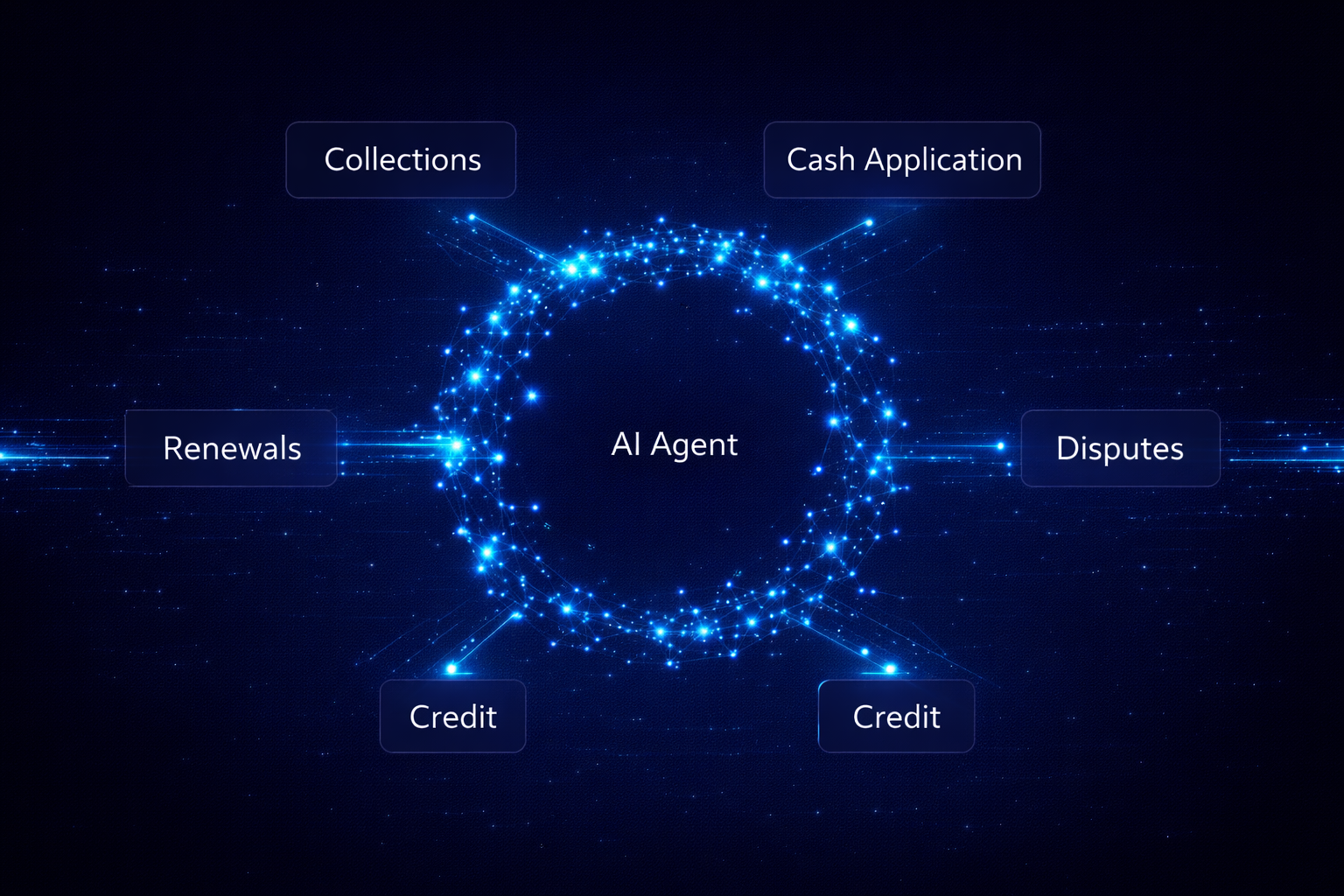
This post is a practitioner's guide to that distinction — what AI agents actually are, what they are currently capable of across the five core O2C workflows, who is actually building them, and the ten questions you need to ask before you let one write to your ERP.
What an AI Agent Actually Is — Three Definitions Worth Knowing
Before evaluating any vendor's claim to offer "agentic AI," it helps to have a definitional anchor that doesn't come from the vendor selling it.
KPMG (February 2026) defines AI agents as "software applications that leverage generative AI and machine learning to autonomously navigate tasks that are complex, multi-step, or involve hand-offs. They have awareness of business contexts and can act proactively or reactively."[1]
Forrester (March 2025) draws the line clearly: "Standalone foundation models can assist with summarization and question-and-answer tasks, but agentic AI systems can go much further: They can plan, decide, and act autonomously, orchestrating complex workflows with minimal human intervention."[2]
ISACA (2025) goes further still: agents "can set their own goals and priorities, plan multi-step actions to achieve objectives, adapt and learn independently from experience, and take initiative without explicit human prompting."[3]
The practical distillation: an AI agent is distinguished from a chatbot and from traditional automation by three things — autonomy (it can take action without being prompted for each step), tool use (it can call APIs, query databases, write to systems), and multi-step reasoning (it can plan a sequence of actions toward a goal, not just respond to a single input).
How this compares to what you may already have:
| Capability | RPA Bot | AI Chatbot | AI Agent |
|---|---|---|---|
| Intelligence | Rule-based only | Pattern matching / NLP | Multi-step reasoning |
| Autonomy | Follows exact programmed steps | Responds to user input | Self-directed goal achievement |
| Learning | None | Limited | Continuous adaptation |
| Task complexity | Repetitive, structured, high-volume | Conversational, moderate | Complex, unstructured, multi-system |
| O2C example | Auto-download remittance files from a portal | Answer "what is my invoice balance?" | Read remittance email → match payment → post to ERP → draft dispute resolution |
The Thomson Reuters Director of AI Integration put this distinction clearly: "One key distinction today is that RPA tools typically do not leverage large language models. That's where the unique value of agentic AI comes in. It uses AI to support decision-making — a capability traditional RPA lacks."[4] A chatbot confirms that a customer qualifies for a refund. It cannot execute the refund, update the ledger, and notify accounting. It informs; it does not resolve.[5]
How Autonomous Is Autonomous? The Maturity Scale
Not all AI agents are created equal, and understanding where on the autonomy spectrum a specific system sits is essential for evaluating both its value and its risk.
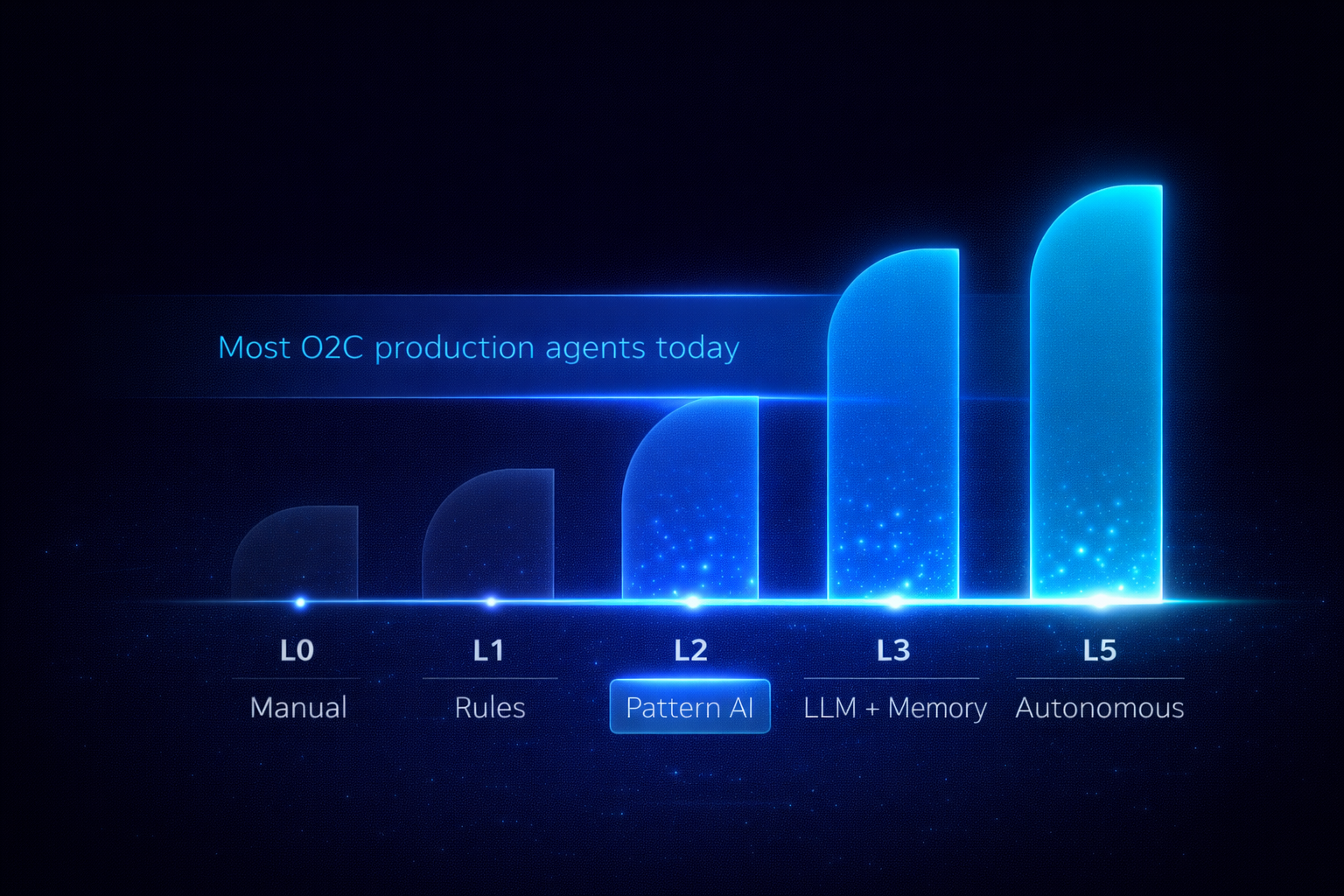
An academic framework published in 2024 draws a direct analogy to automotive autonomy levels:[7][8]
- L0 — No AI: Manual tools only; human executes every step
- L1 — Rule-based AI: Scripted automation; human initiates steps
- L2 — Learning AI: Pattern-based automation; monitored by humans
- L3 — LLM-based with memory: Large language model with reflection and context retention; human oversight at key decision points
- L4 — Autonomous learning: Zero-shot generalization, self-correction; human approval only
- L5 — Personality and collaboration: Human-like reasoning, multi-agent coordination; human as passive consumer
Most O2C AI agents operating in production today function at L2–L3: they use language models to handle unstructured inputs and generate contextual outputs, but they operate within tightly governed workflows with human oversight, especially for high-stakes decisions. A practical L3 example: a collections agent that reads an unstructured dispute email, classifies the dispute type, retrieves the relevant invoice and POD documentation from ERP, and drafts a resolution response — then pauses for a human collector to review and approve before sending.
The L4–L5 vision — where agents negotiate disputes, set credit limits, and close renewals without human review — is not the current production reality. Gartner's Agentic AI Maturity Roadmap projects that fewer than 5% of deployments will reach high autonomy by 2025, and that through 2027, most AI systems will maintain human-in-the-loop oversight.[12] This is not a limitation — it is the correct design for a system that touches your financial records.
The central buyer warning, according to secondary reporting on a Gartner forecast: approximately 40% of agentic AI projects will be canceled by 2027 due to escalating costs and unclear business value, and only approximately 130 agentic AI vendors in the market are legitimate — "agent washing" (rebranding existing automation as AI agents) is widespread.[13] When a vendor claims "AI agents for collections," ask them to walk you through exactly what the agent does, step by step, and where human input is required.
The Five O2C Workflows — What Agents Can Actually Do Today
Collections Agents
Collections is the most mature area of AI deployment in O2C, and also the area with the longest history of automation investment. What agents are capable of as of March 2026: dynamically prioritizing collection queues using payment history, invoice aging, and customer risk signals; drafting and sending personalized dunning emails and portal messages at scale; logging into AP portals (Ariba, Coupa, and others) to upload invoices and retrieve payment statuses; capturing promise-to-pay commitments and scheduling follow-ups; and triggering escalation to human collectors based on payment behavior changes.[14][15] HighRadius claims their collections agent connects to 600+ customer AP portals — a scope of integration that, if accurate, represents a meaningful reduction in the manual portal-login burden that consumes significant collector time. (Vendor-produced claim — verify with a reference customer in your industry.)
The important caveat is data quality. Personalization at scale requires clean, structured customer contact data. An agent generating personalized outreach from incomplete or stale CRM records will produce worse results than a well-designed static dunning template. If your customer master data has accuracy problems, fix those before deploying collections AI — not after.
Impact data: A Billtrust-commissioned Wakefield Research study (October 2025, n=500 finance leaders at North American companies with revenue over $250M) found 99% of companies using AI in AR have reduced DSO; 75% report a six or more day reduction; 82% scaled operations by 11%+ without adding staff.[19] This study was commissioned by a vendor and should be treated as vendor-affiliated data — but the direction is consistent with what practitioners report anecdotally, and the research firm is independent.
What agents cannot yet do well: nuanced multi-party negotiations, managing strategic customer relationships where tone judgment matters above rule application, and producing contextually accurate outbound communications without live ERP grounding (more on hallucination risk below).
Cash Application Agents
This is the second most mature area, and arguably the one with the strongest production evidence. Forrester confirmed it in March 2025: "AI is streamlining cash application processes by analyzing historical invoice and payment patterns to automatically apply new incoming payments to open invoices."[21] The agent captures remittance data from emails, attached PDFs, EDI files, portal downloads, and lockbox files; extracts payment amounts, invoice references, and dispute codes; matches payments to open invoices; posts matched payments to ERP; and flags exceptions for human review.
On auto-match rates — a necessary correction to vendor marketing: every auto-match benchmark in this market comes from a vendor source. HighRadius claims 90%+ auto-match and 95% straight-through processing (STP).[22][23] Emagia claims 95%+ automated matching.[24] Kolleno claims 90%+ match accuracy.[25] Bectran claims "match and apply over 99.9% of payments automatically."[27] No independent, audited benchmark for cash application auto-match rates exists in publicly available literature as of March 2026.[21]
This is not an accusation — it is a buying reality. When evaluating cash application vendors, ask for a named customer reference in your industry, request their measured baseline before implementation and their current rate, and ask specifically how "match" is defined at the line-item level versus the payment level. Forrester independently confirmed cash application as a high-value AI use case — they validated the use case and the direction, but did not publish independent match-rate benchmarks.[21]
A production example (vendor-produced): Johnson & Johnson, working with HighRadius, reported processing 2 million+ invoices annually with a significant reduction in manual cash posting effort. The case study is HighRadius-published and J&J has not issued independent verification — but it is among the more detailed enterprise deployments in the public record.[59]
What requires human review in current production systems: short-pays, missing remittance references, partial payments covering multiple invoices, and deduction claims. The agent can suggest the match; the human approves it.[26][28]
Dispute Management Agents
Dispute management is less mature than collections or cash application but is developing quickly. Current capabilities include: ingesting dispute notifications from customer email, AP portals, and EDI chargebacks; classifying by dispute type (short pay, pricing discrepancy, proof of delivery dispute, credit memo request); routing to the correct team based on classification and dollar amount; and initiating backup document retrieval — POD, invoice copy, contract terms — automatically.[22][29] Classification and routing are the most mature capabilities in this workflow as of March 2026; automated resolution (where the agent closes a dispute, not just routes it) remains largely aspirational in production deployments.
SSON identified dispute resolution and document retrieval as high-impact agentic AI use cases in their August 2025 analysis of O2C automation.[29] The appeal is clear: a dispute intake agent that can read an unstructured customer email, determine it's a POD dispute on invoice #4411, pull the delivery confirmation automatically, and route it to the right person with the evidence package pre-assembled is genuinely valuable — even if a human still makes the final resolution call. Emagia has demonstrated this kind of intake-and-route workflow in vendor demos. (Third-party platform assessment available via CheckThat.ai [24]; no independent production case study verified.)
A production example (vendor-produced): Veeva Systems, a life sciences SaaS company, worked with Tesorio on collections workflow automation and reported material improvement in DSO and collector productivity. The case study is Tesorio-published; Veeva has not issued independent corroboration — but Veeva is a named, verifiable enterprise customer and the case study is more specific than most in this category.[38]
What cannot be autonomously resolved in current systems: high-dollar disputes, disputes requiring contract interpretation, and disputes involving strained customer relationships. Dispute resolution often requires cross-functional coordination across sales, operations, logistics, and finance. The agent can prepare the case; closing it usually still requires a human decision.
Credit Management Agents
AI can automate credit application processing, score customers using payment history and external credit bureau data, generate dynamic credit limit recommendations, trigger real-time credit holds and release recommendations, and accelerate new customer credit setup.[31][32]
This workflow carries the most regulatory complexity of the five, and it deserves careful attention before deployment.
The regulatory reality in 2026: The CFPB stated clearly in January 2024 that creditors must provide specific, explainable adverse action reasons even when complex algorithms are used — a vague "insufficient projected income" disclosure will not satisfy the requirement if an algorithm denied credit on the basis of profession or another non-financial proxy.[33] Colorado's AI Act classifies credit decisions as "consequential decisions" requiring governance controls and impact assessments.[34] California's CCPA automated decision-making technology regulations (approved July 2025) require pre-use notices and opt-out rights for significant AI-driven decisions.[35] Both the Colorado and California regulations are currently written primarily for consumer contexts — but they are establishing the governance expectations that B2B credit automation will increasingly be measured against, even where not yet legally required.
The practical implication: AI-assisted credit scoring with human approval is the appropriate architecture for enterprise deployments in 2026. Fully autonomous credit limit increases or decreases above a materiality threshold, without human review, is a regulatory and operational risk most enterprises should not accept. The explainability requirement is also technical — SHAP and LIME methods are referenced by practitioners, and you need the ability to trace any credit decision to its inputs and explain it.[36]
B2B credit is not subject to FDCPA or ECOA in the same way consumer credit is. But the spirit of those requirements — avoid proxy discrimination, maintain audit trails, provide adverse action explanations — is the emerging standard of practice in commercial credit automation even where not legally required.
Renewals Management Agents
This is the least mature of the five workflows from a pure AI agent standpoint. Agents can automate contract expiration monitoring and early warning alerts, generate renewal outreach based on contract calendars, score churn risk using payment behavior and engagement signals, and integrate with CRM and subscription billing platforms.[37][38][39]
The technology components exist — churn prediction based on payment deterioration is a well-established ML application in subscription businesses. The gap for most mid-market organizations is the data pipeline integration: connecting O2C payment history signals (a customer is going 60+ days past due on invoices) to a renewal-stage CRM workflow (flag this account for proactive intervention before the contract renewal conversation). That cross-functional integration between AR and sales/success systems is where most implementations are still being built.
Honest assessment: no verified named production case studies for O2C-specific renewals agents were identified in this research. This is an area of active vendor marketing and genuine architectural possibility — but confirmed production deployments with quantified results are not yet in the public record.
Who Is Actually Building O2C Agents — and What "Agentic" Means for Each
The established AR automation platforms have all adopted agent language. What they mean by it varies considerably.
HighRadius is the most explicit — they name 15+ individual agents, structured as 9 automated (claiming ≥90% automation rate) and 6 assisted (human-in-the-loop). Their platform is the most frequently cited in enterprise case studies for cash application and collections.[14][15] (All capability claims vendor-produced.)
Esker was named a Leader in the 2024 Gartner Magic Quadrant for Invoice-to-Cash Applications and a Hackett Group Digital World Class provider in the same year — the most independently validated vendor recognition in this landscape.[45][46]
Tesorio explicitly describes "semi-autonomous workflows that preserve human approval for high-value transactions" and "fully automated processes for handling high-volume, low-risk invoices" — which is an honest description of how the best-governed deployments actually work.[54]
Versapay differentiates on collaborative AR — their platform emphasizes network-based payment portals where buyers interact directly, reducing dispute and deduction friction at the source rather than after the fact. (Vendor-produced positioning — independently validated analyst coverage for Versapay as of March 2026 is limited.)
Gaviti, Kolleno, Billtrust, Emagia, and Paraglide all use agent language in marketing; independent analyst validation for these vendors is more limited.[43][44][19][42][48]
A newer cohort of pure-play agent companies — Hyperbots, Lunos.ai, Ledge — are building specifically for cash application with genuinely agentic architectures.[26][28][51] These are earlier-stage compared with the established platforms; vendor financial stability and enterprise readiness warrant evaluation before commitment.
One critical observation: no pre-built, production-ready O2C-specific agent templates from OpenAI, Anthropic, or Google were identified in this research as of March 2026. SAP (Joule), Oracle, and Workday are all announcing embedded AI agents for finance use cases — the production maturity and O2C-specific depth of these native ERP agents varies considerably and is evolving quickly. Finance teams on these platforms should evaluate native ERP agent capabilities before adding a separate point solution, but should verify current production availability rather than relying on roadmap announcements.[50]
Ten Questions to Ask Before You Deploy
The most valuable thing you can do before any O2C agent purchase is slow down the sales process and ask specific, operational questions. Here are the ten that matter most.
On capability authenticity:
1. Walk me through exactly what happens when a remittance arrives with no invoice reference. What does the agent do, step by step, and where does it ask for human input? If the answer is "it uses AI to figure it out," push for specifics. The answer should name the specific logic, the confidence threshold, and what happens when confidence falls below that threshold.
2. What is your production auto-match rate, measured at the task-completion level, with an audited customer example? Not a marketing slide. Not an average across all customers. One named customer, their baseline before implementation, and their current measured rate — with the measurement methodology explained.
3. What is the false positive/negative rate on your prioritization model? How many high-priority accounts turn out to be fine, and how many low-priority accounts slip into serious past-due? This tells you whether the model is genuinely calibrated or optimized for impressive headline metrics.
On architecture and integration:
4. How does your agent connect to our ERP — pre-built bidirectional connector or custom API development? What are the write-back controls? What is the audit trail for every action the agent takes in our ERP?
5. Where is our customer financial data stored and processed? What model provider is used? Does our data train your model? Data residency, model provider identity, and training data policies are standard due diligence items for any AI deployment touching financial records.
On human-in-the-loop design:
6. What is the confidence threshold below which the agent stops and asks for human review? Is it configurable? Is it monitored over time? A system that auto-posts high-confidence matches and queues low-confidence ones for human review is well-designed. A system that doesn't surface its confidence model at all is a risk.
7. What does the approval workflow look like for high-dollar or high-risk decisions? Credit limit changes, dispute resolutions above a materiality threshold, write-off recommendations — these should not be autonomous.
On governance and compliance:
8. Can you produce an audit trail that traces any specific cash posting or credit decision to the data inputs, model output, and human approval (if any) that produced it? If the answer requires engineering work to reconstruct, the system's audit architecture is insufficient for most enterprise finance environments.
9. For collections outreach: how does the system enforce TCPA consent for mobile numbers, opt-out recognition, and communication frequency limits? Even in B2B collections, the FCC's February 2024 ruling applies — AI-generated voice communications require prior express written consent for mobile numbers.[17]
On resilience:
10. What happens when your model drifts? Customer payment behavior changes — economic cycles, industry disruptions, customer-specific financial deterioration. A prioritization model trained on 2022–2023 payment patterns may misrank risk in 2026. What is the retraining cadence, and how will you alert us that accuracy is degrading?[69][70]
The Risks Nobody Puts in the Sales Deck
Hallucination in customer-facing communications is the highest-visibility operational risk. McKinsey's 2024 State of AI survey found approximately 44% of organizations have faced at least one adverse AI effect, with inaccuracies among the most common.[62] The Air Canada chatbot case — decided by a Canadian Civil Resolution Tribunal in 2024, not a US court — established that a company can be held liable when AI provides incorrect information that a customer acts on. It is not US legal precedent, but it is a directionally relevant signal for any enterprise deploying customer-facing AI.
For O2C, the specific risk is an agent drafting a personalized collections email with the wrong invoice balance, a fabricated promise-to-pay date, or an incorrect dispute status. The mitigation is straightforward: ground agents in live ERP data rather than training data for any financial figure, require human review of outbound communications to key accounts or above a materiality threshold, and implement confidence scoring on all generated content.[63][64]
ERP write-back risk is less visible but more consequential. When an agent posts an incorrect cash application — matching a payment to the wrong invoice, duplicating a posting, or applying cash that belongs to a disputed item — the consequences ripple through AR aging, customer statements, revenue recognition, and audit findings. Rubrik launched a product called "Agent Rewind" in August 2025 specifically to enable enterprises to reverse AI agent actions.[66] That a product solving this problem now exists tells you the problem is real. Best practice: auto-post only above a defined confidence threshold; stage everything below it in a review queue; maintain an immutable log of every agent action.[67][54]
Regulatory risks for automated collections communications are narrower than they may seem for B2B teams. The Fair Debt Collection Practices Act governs consumer debt collection by third-party collectors — it does not apply to B2B trade receivables collected by the original creditor, and it does not apply to commercial (business-to-business) debt at all.[68] What does apply: TCPA requirements for AI-generated voice to mobile numbers (B2B included); the growing state-level patchwork of AI governance laws in Colorado, California, and New York City; and GDPR for any cross-border AR operations.[34][35][18]
Model drift is a slow, invisible risk. Static models trained on historical payment behavior become less accurate as conditions change. The leading indicator is your human override rate — when collectors are manually reprioritizing accounts that the system ranked low, the model is drifting. Monitor override rate as a first-order performance signal and build retraining cadence into your vendor contract before deployment.[69][70]
Vendor lock-in is the long-horizon risk most teams discount in the purchase decision. AI agents accumulate institutional knowledge — your customer payment patterns, communication preferences, exception handling history — in vendor-specific data models and proprietary workflow formats. Switching vendors means not just migrating data but rebuilding trained behaviors, exception rules, and integration configurations. Require data portability provisions in the contract, specifically addressing payment history, match rules, and exception handling logs. Favor architectures that abstract the underlying LLM so you can swap model providers without rebuilding workflows. Ask vendors whether their integrations use open API standards or proprietary connectors.[71][72][73]
Where to Start
The research and the honest case study evidence point to a clear sequencing for O2C teams evaluating AI agents.
Start with cash application if you have high payment volume and a documented unapplied cash problem. This is the most mature, best-evidenced use case. The ROI math is straightforward: if your team is spending significant hours per week manually matching payments, and an agent can reliably handle 80–90% of high-confidence matches, the time reclaimed is immediate and measurable. Run a pilot on a representative sample across payment types — not just your cleanest ACH payments from your top payers, but a cross-section that includes remittance-light payments and partial payments. Measure the match rate against your current baseline for that same sample, and use those numbers to build the business case for broader deployment.
Add collections prioritization and outreach automation as the second layer. The collections agent use case is well-documented, the ROI (DSO reduction, collector productivity) is measurable, and the risk profile is manageable with basic human-in-the-loop design. Start with automated outreach for low-balance, standard-terms accounts — the segment your collectors are least engaged with anyway — and measure promise-to-pay capture rate and days-to-collect against your pre-automation baseline.
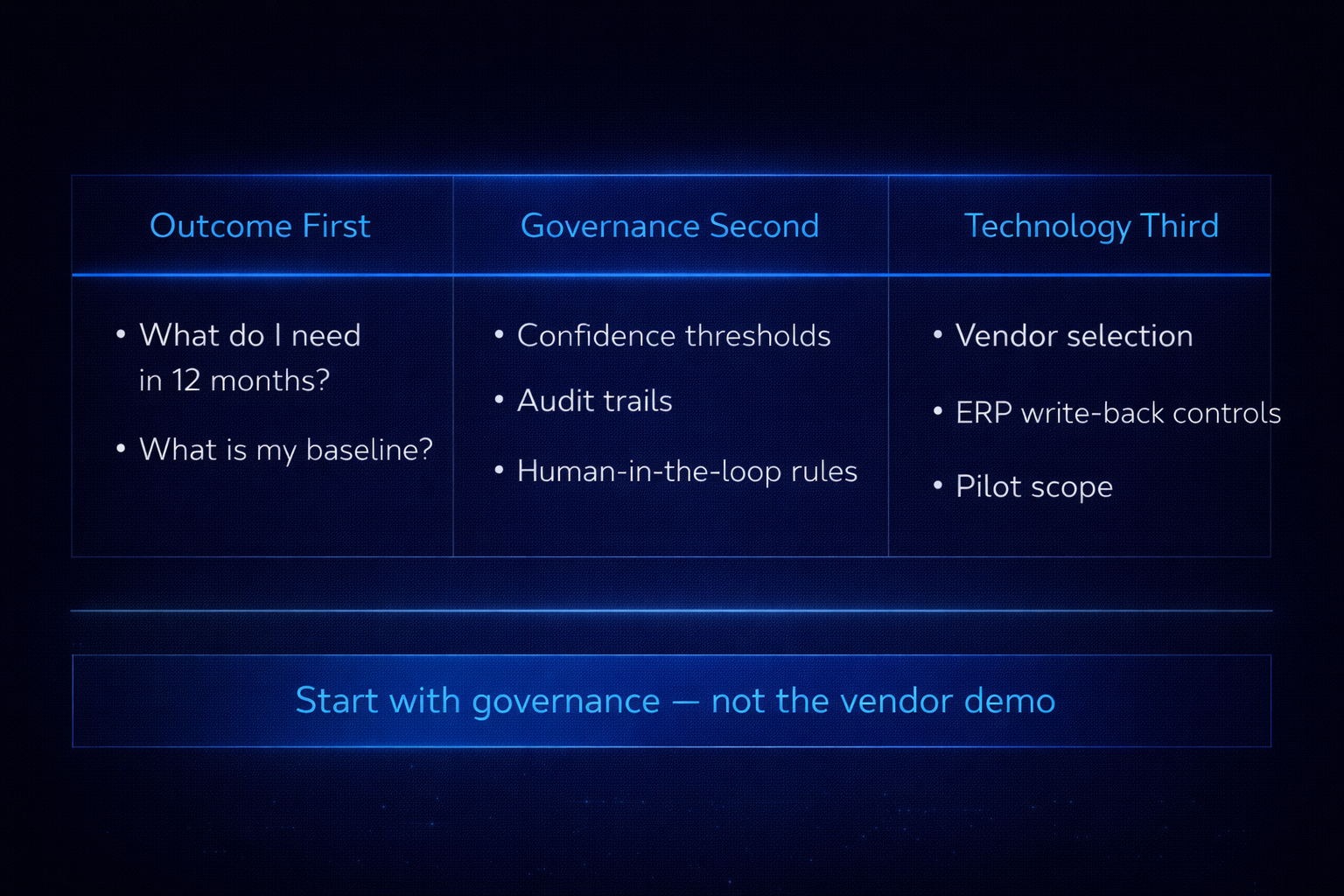
Build governance infrastructure before you deploy anything, not after. The organizations reporting meaningful AI value today are not the ones who deployed fastest — they're the ones who built confidence thresholds, audit trails, escalation rules, and model performance monitoring before turning agents loose on their ERP. The gap between AI ambition and AI value is governance and data quality, not technology availability.
Hold on credit automation and disputes until your data infrastructure is solid. Both workflows carry higher regulatory complexity and operational risk than cash application or collections outreach. They are worth pursuing — but after you have a track record of well-governed production deployment in simpler workflows, not as a first implementation.
For renewals agent integration — connecting AR payment behavior to CRM renewal workflows — plan for a cross-functional data integration project, not a software purchase. The technology exists; the organizational work of connecting finance operations data to your sales or customer success team's systems is where most of the effort lives.
The Honest Summary
AI agents are delivering real, measurable value in O2C — most clearly in cash application matching and collections prioritization. The technology is genuine, the production deployments exist, and the directional evidence, even accounting for vendor-originated sourcing, is consistent: teams deploying well-governed agents are processing more volume with less manual effort and collecting faster.
The honest calibration for March 2026: most production O2C AI agents operate at L2–L3 on the autonomy scale. They use language models to handle unstructured inputs and generate contextual outputs within tightly governed workflows with meaningful human oversight on high-stakes decisions. The fully autonomous O2C — where agents negotiate disputes, set credit limits, and manage renewals without human review — is not the current production reality, and it should not be your near-term architecture target. Not because the technology couldn't eventually get there, but because the regulatory, financial integrity, and customer relationship risks are not yet solved by any vendor in this market.
Gartner puts the current moment plainly: 58% of finance functions are now using AI in some form, but only 8% have it in full production — most deployments are still in pilot.[78] The organizations that move from pilot to production successfully are the ones that started with governance before deployment, started with the simplest, highest-confidence use case, measured their baseline before implementation, and treated the human-in-the-loop as a feature rather than a failure to automate.
Twelve months from now, the autonomy benchmarks will have moved — L3 will be more reliable, more platforms will have solved the ERP write-back audit problem, and the production case study record will be richer. The questions in this post will still be the right ones to ask; the answers you get will be better.
The highest-value question for an O2C leader evaluating this technology is not "is this vendor's agent real?" It is: what specific, measurable outcome do I need in the next 12 months, what is my current baseline, and what governance infrastructure needs to be in place before I let an agent write to my ERP? That sequence — outcome first, governance second, technology third — is what separates the 14% of organizations reporting meaningful AI value today from the 66% still waiting for it.[55]
REFERENCES
- KPMG — The rise of agentic AI in financial services (Feb 2026) — https://assets.ctfassets.net/9crgcb5vlu43/2TYpxzJpnG5IcIhD9pKc5M/9d701452355eeef0b51a949628c095fc/The_rise_of_agentic_AI_in_financial_services.pdf
- Forrester — Agentic AI Is The Next Competitive Frontier (Mar 2025) — https://www.forrester.com/blogs/agentic-ai-is-the-next-competitive-frontier/
- ISACA — AI Agents and Agentic AI: Understanding the Difference — https://www.isaca.org/resources/news-and-trends/isaca-now-blog/2025/ai-agents-and-agentic-ai-understanding-the-difference-that-matters-for-your-organization
- Thomson Reuters — AI agents versus RPA: A guide for accountants — https://tax.thomsonreuters.com/blog/ai-agents-versus-rpa-a-guide-for-accountants-tri/
- Acropolium — AI Agents vs RPA vs Chatbots (editorial overview) — https://acropolium.com/blog/ai-agents-vs-rpa-vs-chatbots/ (Acropolium is a software development agency — this is vendor-adjacent editorial content, not an independent research source; cited for general comparison framing only)
- Solace — Gartner on AI Agent Development: Our Insights — https://solace.com/blog/ai-agent-dev-frameworks-gartner/
- arXiv — Levels of AI Agents: from Rules to Large Language Models (2024) — https://arxiv.org/pdf/2405.06643.pdf
- alphaXiv — Levels of AI Agents overview — https://alphaxiv.org/overview/2405.06643v2
- Knight First Amendment Institute — Levels of Autonomy for AI Agents — https://knightcolumbia.org/content/levels-of-autonomy-for-ai-agents-1
- Architecture & Governance — Five Maturity Levels of Agentic AI — https://www.architectureandgovernance.com/applications-technology/examining-the-five-maturity-levels-of-agentic-ai/
- Skan.ai — Gartner Agentic AI Maturity Roadmap — https://www.skan.ai/analyst-reports/2025-gartner-agentic-ai-maturity-roadmap
- Jaggaer — Gartner Agentic AI Maturity Roadmap — https://www.jaggaer.com/resources/analyst-reports/gartner-agentic-ai-maturity-roadmap
- Digital Applied — AI in 2026: Predictions, Trends & Industry Forecast — https://www.digitalapplied.com/blog/ai-predictions-2026-trends-forecast
- HighRadius — Future of Collections: AI's Impact on O2C Workflows — https://www.highradius.com/finsider/practical-use-cases-of-ai-in-o2c/
- HighRadius — Agentic AI for Collections Management — https://www.highradius.com/resources/platform/automated-collections-software/
- Paraglide AI — How AI Agents Are Automating the Full O2C Cycle — https://www.paraglide.ai/blog/agentic-ai-in-order-to-cash-how-ai-agents-are-automating-the-full-o2c-cycle
- Parker Poe — The TCPA Tightrope: Why 2025 Is a Turning Point — https://www.parkerpoe.com/news/2025/10/the-tcpa-tightrope-why-2025-is-a-turning
- Hostie.ai — 2025 TCPA & FCC Compliance Checklist — https://hostie.ai/resources/2025-tcpa-fcc-compliance-checklist-ai-voice-calls-restaurants (Hostie.ai is an AI voice platform vendor — this is a vendor-produced compliance summary; cited for general context, not as primary legal authority. [17] Parker Poe is the primary legal citation for TCPA.)
- Billtrust — AI in Accounts Receivable Reduces DSO, Study Finds — https://www.billtrust.com/news/study-finds-ai-in-accounts-receivable-reduces-dso
- HighRadius — AI in Collections: From Manual Tasks to Intelligent Action — https://www.highradius.com/resources/Blog/ai-in-collections-from-manual-tasks-to-intelligent-action/
- Forrester — Top AI Use Cases For Accounts Receivable Automation In 2025 — https://www.forrester.com/blogs/top-ai-use-cases-for-accounts-receivable-automation-in-2025/
- HighRadius — The Role of Agentic AI in Accounts Receivable — https://www.highradius.com/resources/Blog/5-ways-agentic-ai-can-transform-accounts-receivable-management/
- HighRadius — Automated Cash Application: A Strategic CFO Priority in 2026 — https://www.highradius.com/resources/Blog/8-benefits-automating-cash-application-process/
- CheckThat.ai — Emagia platform assessment (third-party review site) — https://checkthat.ai/brands/emagia
- Kolleno — Best Cash Application Software for Enterprise: 2025 Buyer's Guide — https://www.kolleno.com/best-cash-application-software-for-enterprise-2025-buyers-guide/
- Hyperbots — Cash Application Co-Pilot — https://www.hyperbots.com/copilots/cash-application
- Bectran — AI-Driven Cash Application — https://www.bectran.com/ai/ai-cash-app
- Lunos.ai — How to Improve Your Cash Application Process With AI Agents — https://www.lunos.ai/blog/cash-application-process-ai
- SSON — Introducing Generative & Agentic AI into the O2C Process (Aug 2025) — https://www.ssonetwork.com/finance-accounting/articles/generative-agentic-ai-order-to-cash
- Emagia — AI for Order-to-Cash — https://www.emagia.com/resources/glossary/artificial-intelligence-ai-for-order-to-cash/
- Everworker.ai — Top AI Agent Scenarios Transforming Corporate Finance in 2024 — https://everworker.ai/blog/ai_agent_scenarios_corporate_finance_2024
- Skadden — CFPB Applies Adverse Action Notification Requirement to AI (Jan 2024) — https://www.skadden.com/insights/publications/2024/01/cfpb-applies-adverse-action-notification-requirement
- Venable — AI in Financial Services: Popular Use Cases and Regulatory Landscape (Feb 2026) — https://www.venable.com/insights/publications/2026/02/ai-in-financial-services-popular-use-cases
- WSGRDA — CPPA Approves New CCPA Regulations on AI (July 2025) — https://www.wsgrdataadvisor.com/2025/07/cppa-approves-new-ccpa-regulations-on-ai-cybersecurity-and-risk-governance-and-updates-data-broker-regulations/
- HES FinTech — AI in Lending: Credit Regulations 2025 — https://hesfintech.com/blog/all-legislative-trends-regulating-ai-in-lending/
- Esker — Named Leader in 2024 Gartner Magic Quadrant for Invoice-to-Cash — https://www.esker.com/en-gb/company/press-releases/esker-named-leader-2024-gartnerr-magic-quadranttm-invoice-cash-applications/
- Esker — Named in Hackett Group Customer-to-Cash Research 2024 — https://betterbusiness-fbnz.fujifilm.com/esker-hackett-group-world-class-2024/
- Tesorio — Veeva Systems case study — https://www.tesorio.com/resources/customers-veeva
- Paraglide AI — Automating Accounts Receivable with AI Agents in 2026 — https://www.paraglide.ai/blog/how-ai-agents-automate-accounts-receivable
- Outreach.io — Agent washing exposed: Why 40% of AI projects fail — https://www.outreach.io/resources/blog/agent-washing-ai-projects-fail-guide
- The CTO Advisor — Agentic AI Is Everything — But Should You Let Someone Else Own It? — https://thectoadvisor.com/blog/2025/07/23/agentic-ai-is-everything-but-should-you-let-someone-else-own-it/
- Ledge — Best cash application software in 2025 — https://www.ledge.co/content/cash-application-software
- Tesorio — Transforming Cash Flow, Reducing DSO, Optimizing Collections — https://www.tesorio.com/blog/transforming-cash-flow-reducing-dso-and-optimizing-collections-with-transparent-ai-the-tesorio-advantage
- RGP — CFO Survey Shows Growing Divide Between AI Ambition and AI Readiness (Dec 2025) — https://rgp.com/press/rgp-cfo-survey-shows-growing-divide-between-ai-ambition-and-ai-readiness/
- CFO Dive — Top 5 AI Adoption Challenges Facing CFOs in 2026 — https://www.cfodive.com/news/top-5-ai-adoption-challenges-facing-cfos-in-2026/810277/
- Robotalker — Debt Collection Compliance Guide 2025 — https://robotalker.com/blogs/debt-collection-compliance-guide-2025
- Forbes — The Hallucination Tax: Generative AI's Accuracy Problem (Dec 2025) — https://www.forbes.com/councils/forbesbusinesscouncil/2025/12/18/the-hallucination-tax-generative-ais-accuracy-problem/
- Dev.to — Why your AI agent keeps hallucinating financial data — https://dev.to/valyuai/why-your-ai-agent-keeps-hallucinating-financial-data-and-how-to-fix-it-180d
- Reworked.co — Rubrik Launches Agent Rewind to Reverse AI Agent Errors (Aug 2025) — https://www.reworked.co/digital-workplace/rubrik-launches-agent-rewind-to-reverse-ai-agent-errors/
- LinkedIn — Multi-Agent Systems With Rollback Mechanisms — https://www.linkedin.com/pulse/multi-agent-systems-rollback-mechanisms-dean-mai-leuse
- Gaviti — How Predictive AI Is Transforming Accounts Receivable in 2025 — https://gaviti.com/how-predictive-ai-is-transforming-accounts-receivable/
- Xtrace.ai — AI Vendor Lock-In: Who Really Owns Your Competitive Advantage? — https://xtrace.ai/blog/ai-vendor-lock-in
- Swfte.com — How Enterprises Are Escaping AI Vendor Lock-in in 2026 — https://www.swfte.com/blog/avoid-ai-vendor-lock-in-enterprise-guide
- TechMonitor — 58% of finance functions using AI in 2024, finds Gartner survey — https://www.techmonitor.ai/ai-and-automation/58-of-finance-functions-using-ai-in-2024-finds-gartner-survey
- CFO Dive — CFOs' AI adoption slows as challenges mount: Gartner — https://www.cfodive.com/news/cfos-ai-adoption-slows-challenges-mount-gartner/805949/
- Joget — AI Agent Adoption 2026: What the Data Shows — https://joget.com/ai-agent-adoption-in-2026-what-the-analysts-data-shows
- KPMG — The Future of Agentic Finance (Nov 2025) — https://kpmg.com/us/en/articles/2025/future-agentic-finance.html
- AppZen — Agentic AI for AP: A new era for finance leaders — https://www.appzen.com/resources/agentic-ai-for-ap-new-era-for-finance-leaders
- HighRadius — Johnson & Johnson Automation Formula — https://www.contentree.com/caseStudy/johnson-and-johnsons-automation-formula_408443
- HighRadius — Caliber Collision 95% Straight-Through Processing — https://www.highradius.com/resources/Radiance/fixing-cash-application-to-achieve-95-straight-through-processing-2/
- McKinsey — State of AI 2024 — https://www.mckinsey.com/capabilities/quantumblack/our-insights/the-state-of-ai-in-2024
- Val Intelligence — AI Hallucination Risk in Financial Systems (2025) — https://www.vals.ai/research/hallucination-risk-finance
- Prompt Engineering Institute — Grounding LLMs in Financial Data (2025) — https://www.promptengineering.org/llm-grounding/
- Rubrik — Agent Rewind Product Launch (Aug 2025) — https://www.rubrik.com/blog/agent-rewind-launch
- Enterprise Strategy Group — AI Agent Governance Best Practices (2025) — https://www.esg-global.com/research/ai-agent-governance
- Harvard Business Review — Fair Debt Collection Practices Act scope and B2B application (2024) — https://hbr.org/2024/03/fair-debt-collection-practices-act-scope
- Databricks — Model Monitoring for Financial AI Systems (2025) — https://www.databricks.com/blog/model-monitoring-financial-ai
- Accenture — Drift Detection in Production AI Systems (2025) — https://www.accenture.com/us-en/insights/artificial-intelligence/drift-detection-ai-systems
- Gartner — Vendor Lock-In Risks in AI Systems (2025) — https://www.gartner.com/en/articles/vendor-lock-in-ai-systems
- Forrester — API Standards for AI Agent Portability (2025) — https://www.forrester.com/blogs/api-standards-ai-agent-portability
- IDC — Data Portability and AI Vendor Selection (2025) — https://www.idc.com/articles/data-portability-ai-vendors
- Gartner — 2025 Finance AI Adoption Survey — https://www.gartner.com/en/articles/finance-ai-adoption-survey-2025